
AI in SDLC: How Enterprises Reduce Cycle Time, Rework, and Risk with Connected Intelligence
Speed has become a defining expectation in modern software delivery. Business leaders expect faster releases, engineering teams are pushed to compress timelines, and customers demand continuous improvement without disruption. Yet despite years of investment in Agile methods, DevOps pipelines, and cloud platforms, many enterprises still struggle to meaningfully reduce end-to-end SDLC cycle time.
The issue is not a lack of tools or automation. Most enterprises already have sophisticated CI/CD pipelines, test frameworks, and monitoring platforms in place. The real challenge lies deeper in how decisions are made, validated, and carried forward across the software lifecycle.
This is where AI is beginning to fundamentally change the SDLC. Not by accelerating individual tasks in isolation, but by reducing the friction, uncertainty, and rework that silently inflate cycle time across every phase.
Why SDLC Cycle Time Remains an Enterprise Challenge
In large organizations, SDLC delays rarely originate from a single bottleneck. Instead, they accumulate gradually as work moves from requirements to design, development, testing, deployment, and operations.
Requirements are often incomplete or ambiguous, leading to downstream clarifications. Design decisions are made without full visibility into operational constraints. Testing uncovers gaps late in the cycle, while deployment exposes risks that were never considered upstream. Each of these handoffs introduces context loss, rework, and delay.
Industry data reinforces this reality. Statista highlights that a significant portion of total development effort in enterprise environments is spent on defect resolution, rework, and unplanned changes rather than net-new feature delivery. This means that cycle time is extended not because teams move slowly, but because they are repeatedly correcting avoidable issues.
Enterprises that focus only on accelerating execution faster coding, faster testing, faster deployments often see diminishing returns. Without addressing the quality of decisions that drive execution, speed alone does not translate into efficiency.
The Real Lever: Improving Decisions Before Work Begins
High-performing organizations approach SDLC acceleration differently. Instead of optimizing individual stages in isolation, they focus on improving decision quality early and consistently across the lifecycle.
This shift is subtle but powerful. Decisions made during requirements and design have an outsized impact on everything that follows. When those decisions are clearer, more complete, and better informed by historical outcomes, the entire lifecycle becomes more predictable.
AI plays a critical role here. When applied as a connected intelligence layer rather than a standalone tool, AI helps enterprises identify gaps earlier, surface risks sooner, and reduce the need for corrective work later. The result is a natural compression of cycle time without sacrificing quality.
How AI Reduces SDLC Cycle Time in Practice
Across enterprises adopting AI as part of their SDLC operating model, several consistent patterns emerge. These patterns are not tied to a single technology or phase; they reflect systemic improvements enabled by connected intelligence.
Faster Backlog Readiness Through AI-Assisted Requirements
One of the most impactful areas for cycle time reduction is requirements engineering. Poorly defined requirements lead to churn across development, testing, and deployment.
AI-assisted requirements analysis helps structure user stories, identify missing acceptance criteria, flag ambiguities, and ensure non-functional requirements are considered early. By improving clarity upfront, teams significantly reduce the time spent revisiting and reworking backlog items.
Enterprises applying AI in this stage commonly achieve 80% faster backlog readiness, enabling teams to move from ideation to execution with far less friction.
Design Acceleration Through Context-Aware Intelligence
Design delays often stem from incomplete context rather than complexity alone. Architects and technical leaders must balance business needs, system constraints, and operational realities often under time pressure.
AI-driven design intelligence accelerates this process by leveraging existing documentation, architectural patterns, and historical outcomes to generate first-pass designs and highlight potential risks. While human expertise remains central, AI reduces manual effort and shortens iteration cycles.
This leads to faster alignment, fewer late-stage design changes, and smoother transitions into development.
Reducing Development Rework Through AI-Guided Execution
AI in development is frequently associated with code generation, but its true impact lies in reducing misalignment. When developers work with clearer intent derived from well-structured requirements and validated designs rework naturally declines.
AI-guided development reinforces standards, highlights risky patterns, and ensures that implementation aligns with upstream decisions. This reduces the need for downstream corrections and shortens the feedback loop between intent and execution.
Over time, this leads to more predictable development cycles and fewer disruptions late in the sprint.
Scaling QA Without Slowing Delivery
Testing is a critical phase for quality, but it is also a common source of delay. Manual test design and execution struggle to keep pace with rapid development, often forcing teams to choose between speed and coverage.
AI-driven QA changes this equation. By generating test cases from requirements and code context, identifying missing scenarios, and prioritizing high-risk paths, AI enables broader coverage with less manual effort.
Organizations applying AI in QA consistently see 60% reductions in manual testing effort, while improving defect detection earlier in the lifecycle. This directly contributes to shorter cycle times and higher release confidence.
Predictive Deployment Instead of Reactive Fixes
Deployment and post-release incidents represent some of the most expensive cycle-time setbacks. Rollbacks, hotfixes, and emergency patches disrupt teams and divert focus from planned work.
AI-driven deployment intelligence reduces these disruptions by assessing release risk before code goes live. By correlating changes with historical incidents, non-functional risk patterns, and operational signals, AI enables teams to anticipate problems rather than react to them.
Enterprises using predictive deployment approaches report 35% fewer production incidents, significantly reducing unplanned work and stabilizing delivery timelines.
The Compounding Effect of Connected Intelligence
The largest gains in SDLC cycle time do not come from isolated AI applications. They emerge when AI is applied as a connected intelligence layer across the entire lifecycle.
When insights flow from requirements to design, from development to testing, and from production back into planning, learning compounds over time. Each release becomes more informed than the last, and decision quality steadily improves.
This is the foundation of Narwal’s AI-in-SDLC approach treating AI not as a point solution, but as an operating model that preserves context and accelerates outcomes at scale.
Why Cycle Time Reduction Is a Leadership Metric
For enterprise leaders, SDLC cycle time is more than an engineering concern. It directly affects time-to-market, customer satisfaction, operational risk, and business agility.
Reducing cycle time through AI enables leaders to move from reactive delivery to predictable execution. It allows organizations to balance speed with quality and innovation with stability. Most importantly, it shifts the conversation from “How fast can we ship?” to “How confidently can we deliver?”
From Faster Delivery to Sustainable Advantage
AI reduces SDLC cycle time not by skipping steps or replacing human judgment, but by improving how decisions are made and carried forward across the lifecycle.
By reducing ambiguity, preventing rework, and anticipating risk, AI transforms the SDLC from a sequence of handoffs into a continuously learning system.
Enterprises that embrace this model will not only deliver faster they will deliver with confidence, consistency, and measurable business impact.
Join the Conversation
In our on-demand webinar, “Accelerating the SDLC with AI: From Development to Deployment,” we walk through real enterprise patterns demonstrating how AI reduces cycle time across requirements, development, testing, deployment, and operations without compromising governance or control.
You’ll see how AI transforms the SDLC into a connected, continuously learning system that delivers speed with confidence and measurable business impact.
See how connected intelligence changes delivery outcomes
Resources
- Statista – Software Development Effort Distribution
A large portion of enterprise development effort is consumed by defect resolution, rework, and unplanned changes.
- McKinsey – Shifting Quality Left in the SDLC
Improving early-stage decision quality can reduce overall rework by ~30%.
- Forrester – AI in End-to-End Software Delivery
Enterprises applying AI across SDLC decision points reduce delivery delays and improve predictability.
- Gartner – Decision-Centric AI & SDLC Performance
AI embedded into lifecycle decision points delivers higher, more sustainable ROI than isolated automation.
Related Posts

AI document processing: automating binder-to-policy review
Summary AI document processing can take the manual, field-by-field work out of binder-to-policy review, where quiet mismatches in commercial insurance are easy to miss. Narwal repurposed its existing RAG Bot accelerator into a placement-ready workflow…

- Oct 01
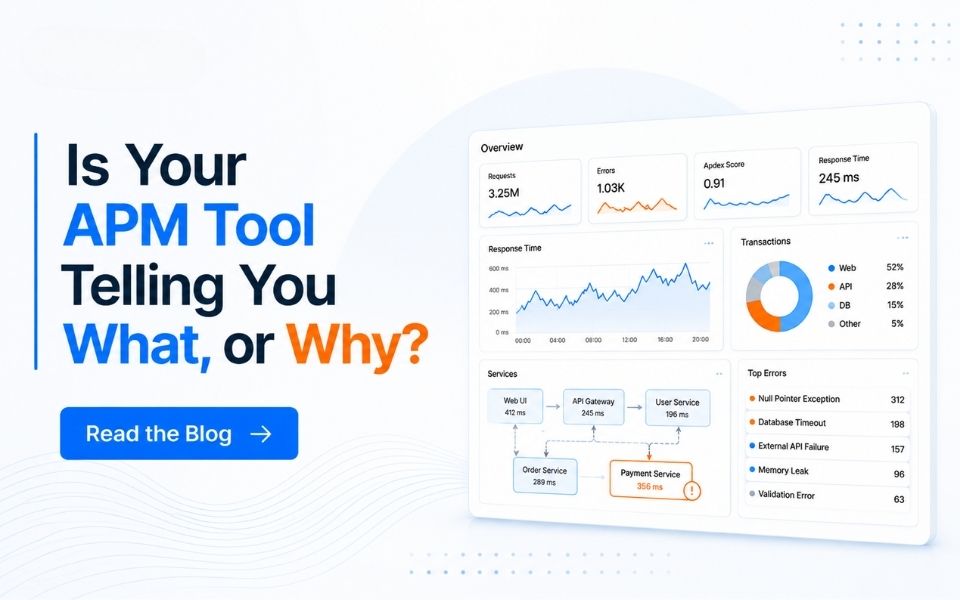
Application Performance Monitoring: The 2026 Guide to Key Metrics, Tools, and Root Cause Analysis
Modern applications rarely fail in one obvious place. A slow checkout page might trace back to a database query three services away. A spike in errors might be a downstream API silently timing out. Application…
- Sep 02
Categories
Latest Post

AI document processing: automating binder-to-policy review
- October 1, 2026


How AI Tests AI: Inside Autonomous Quality Engineering
- September 18, 2026


Headquarters
8845 Governors Hill Dr, Suite 201
Cincinnati, OH 45249
Our Branches
Cincinnati | Jacksonville | Indianapolis | London | Hyderabad | Bangalore | Pune
Narwal | © 2024 All rights reserved