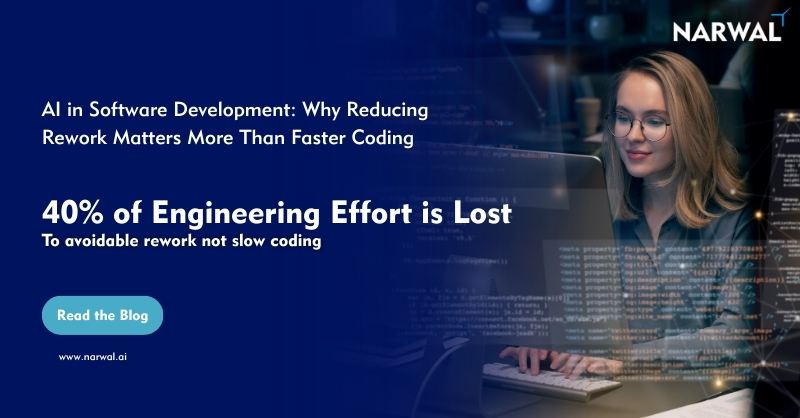
AI in Software Development: Why Reducing Rework Matters More Than Faster Coding
Why Faster Coding Hasn’t Fixed Software Delivery
AI has rapidly become a fixture in modern software development. Code copilots, automated refactoring tools, and AI-assisted IDEs promise dramatic productivity gains. Developers write code faster, generate boilerplate instantly, and troubleshoot with fewer keystrokes.
Yet for many enterprises, delivery outcomes remain stubbornly unchanged.
Release timelines still slip. Rework continues to consume engineering capacity. Quality issues surface late often in testing or production.
McKinsey notes that while AI-assisted development tools can improve individual developer productivity by 45%, these gains often fail to translate into faster end-to-end delivery when upstream and downstream constraints remain unchanged.
The reason is simple: software delivery problems rarely originate in code creation alone.
The Hidden Cost of Rework in Software Development
Rework is one of the most expensive and least visible drains on engineering productivity.
According to Statista, software development rework accounts for a significant portion of engineering effort in large enterprises, with requirements-related issues consistently ranking among the top causes of project delays and cost overruns.
Gartner further estimates that over 40% of engineering effort in complex software programs is spent on avoidable rework driven by unclear requirements, late-stage changes, and insufficient early validation.
Common sources of rework include:
- Ambiguous or incomplete requirements
- Late discovery of edge cases and non-functional risks
- Design decisions made without downstream context
- Misalignment between development, testing, and operations
When these issues surface late, the cost multiplies. Fixes require code changes, test rewrites, deployment delays, and often production remediation.
Writing code faster does not eliminate these problems. It often accelerates them.
Why AI in Development Alone Delivers Limited ROI
AI copilots excel at improving local productivity helping individual developers write or modify code more efficiently. But when applied in isolation, they inherit the same limitations as traditional development tools.
Gartner research shows that organizations focusing AI investments primarily on coding and task automation often experience diminishing returns beyond early adoption, because AI remains disconnected from requirements, testing, and operational feedback loops.
AI that operates only at the coding phase:
- Has no visibility into why a feature exists
- Cannot assess whether requirements are complete or testable
- Does not account for downstream operational risk
- Lacks feedback from production behavior
As a result, AI improves speed without improving decision quality.
This is why many enterprises see strong pilot outcomes but struggle to realize consistent, scalable delivery improvements.
Where Software Delivery Actually Slows Down
To reduce cycle time meaningfully, enterprises must address where delays really originate.
According to Forrester, the largest contributors to delivery delays are not coding velocity, but:
- Backlog instability and requirement churn
- Late-stage testing bottlenecks
- Risk-driven release hesitation
- Incident-driven unplanned work
Forrester analysis indicates that a material share of SDLC delays occurs before code reaches QA, driven by unclear requirements and insufficient early validation.
These are lifecycle problems, not development problems.
The Shift: AI That Shapes Decisions Before Code Is Written
High-performing engineering organizations are rethinking how AI is applied in software development.
Instead of focusing only on AI-assisted coding, they apply AI earlier in the lifecycle, where leverage is highest:
- Structuring and validating requirements
- Detecting gaps, risks, and ambiguities early
- Generating design alternatives and impact views
- Ensuring testability and non-functional coverage upfront
McKinsey emphasizes that enterprises shifting quality and validation earlier in the SDLC can reduce overall rework by 30%, while significantly improving delivery predictability.
When AI improves the quality of inputs into development, coding becomes faster and more reliable not just quicker.
From Coding Assistance to Development Intelligence
This shift reframes the role of AI in software development:
Traditional View | AI-Driven View |
Speed up coding | Reduce rework |
Optimize developers | Optimize decisions |
Local productivity | End-to-end flow |
Reactive fixes | Proactive assurance |
In this model, AI acts as a continuous intelligence layer that informs development decisions with upstream and downstream context.
Gartner describes this evolution as decision-centric AI, where the primary objective is improving decision quality across interconnected processes, not automation for its own sake.
Business Impact of AI-Driven Development Intelligence
Enterprises applying AI across requirements, design, and development are seeing tangible outcomes:
- 80% faster backlog readiness through AI-assisted requirement refinement and design clarity
- 30% reduction in rework cycles due to early gap detection
- Improved testability and quality before code reaches QA
- More predictable development velocity sprint over sprint
Forrester reports that organizations embedding AI across lifecycle decision points achieve higher and more sustainable ROI than those deploying AI in isolated functional silos.
Why Development Leaders Must Rethink AI Adoption
For engineering leaders, the key question is no longer:
“How can AI help my developers code faster?”
It is:
“How can AI help my teams make better decisions earlier?”
Gartner predicts that enterprises embedding AI into SDLC decision points rather than treating it as a productivity add-on will outperform peers on delivery speed, quality, and cost efficiency over the next three to five years.
When AI is treated as a development add-on, it benefits the plateau quickly. When it is embedded as part of the SDLC operating model, it impacts compounds over time.
From Development Productivity to Delivery Confidence
True acceleration in software development comes from reducing uncertainty, not just increasing output.
When requirements are clearer, designs are validated earlier, and risks are surfaced before code is written, development naturally becomes faster, smoother, and more predictable.
This is how AI moves from developer productivity to delivery confidence.
Join the Conversation
In our upcoming live webinar, “Accelerating the SDLC with AI: From Development to Deployment,” we’ll explore how enterprises are applying AI across the lifecycle from requirements and design through development, testing, and operations to reduce rework and accelerate delivery with confidence.
📅 January 29, 2026 | ⏱ 10:00 AM – 11:00AM EST | 💻 Live on Zoom
Secure your spot to see AI in-SDLC in action
Resources
- McKinsey – Developer Productivity and AI-Assisted Engineering (2023)
AI tools improve individual developer productivity by up to ~45%, but do not automatically reduce end-to-end delivery timelines.
- Statista – Software Development Rework & Project Cost Drivers
Rework and requirements-related issues rank among top contributors to enterprise software delays and overruns.
- Gartner – Engineering Rework and SDLC Inefficiencies
Over 40% of engineering effort in complex programs attributed to avoidable rework caused by unclear requirements and late changes.
- Forrester – SDLC Bottleneck Analysis
Backlog instability, late testing, and release risk contribute more to delivery delays than coding velocity.
Related Posts
Why Multi-Modal AI is Becoming Critical for Enterprise Decision-Making
Most enterprise AI deployments still work one data type at a time: text, or images, or sensor data, rarely all three together, and almost never in a way that drives a decision rather than a…

- Jul 15
Scaling Enterprise AI: From Gen AI Pilots to Measurable Business Outcomes
Enterprise AI has entered its third phase: past experimentation, past the Gen AI pilot rush, and now facing the hardest part, scaling AI to deliver measurable business outcomes. Most organizations already have access to sophisticated…
- Jul 14
Categories
Latest Post



Headquarters
8845 Governors Hill Dr, Suite 201
Cincinnati, OH 45249
Our Branches
Cincinnati | Jacksonville | Indianapolis | London | Hyderabad | Bangalore | Pune
Narwal | © 2024 All rights reserved