
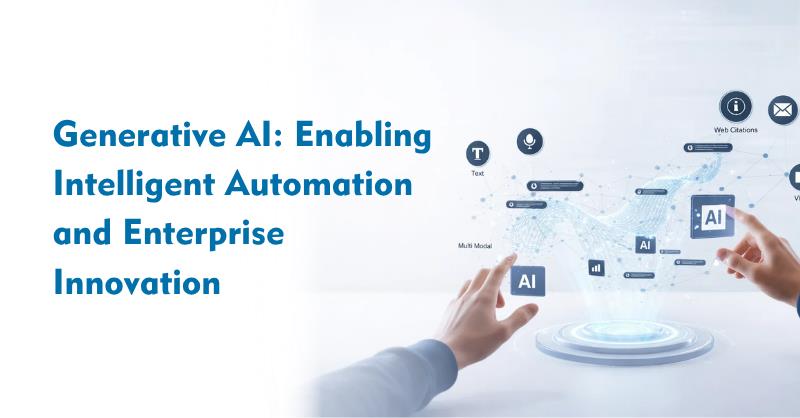
Generative AI is rapidly transforming how enterprises innovate, automate, and deliver value. From intelligent virtual assistants to autonomous workflow orchestration, Generative AI is enabling organizations to move beyond traditional analytics and automation toward context-aware, adaptive, and scalable decision-making systems.
As enterprises accelerate digital transformation, Generative AI services are emerging as a strategic capability enabling businesses to unlock productivity gains, enhance customer experiences, and build intelligent operating models. However, realizing enterprise-grade value from Generative AI requires more than deploying large language models. It requires structured architecture, governance frameworks, domain-aligned use cases, and scalable integration across enterprise systems.
Organizations that adopt a structured Generative AI services approach can accelerate innovation cycles, reduce manual effort, and build resilient digital ecosystems that are prepared for future AI advancements.
The Growing Enterprise Need for Generative AI
Modern enterprises operate in increasingly complex environments characterized by data proliferation, rising customer expectations, and pressure to deliver faster business outcomes. Traditional automation and analytics approaches often struggle to scale due to fragmented workflows and limited contextual intelligence.
Generative AI addresses these challenges by enabling systems that can generate content, interpret information, automate decision flows, and collaborate across platforms.
Key enterprise drivers accelerating Generative AI adoption include:
- Increasing demand for hyper-personalized customer experiences
- Need for faster product innovation and time-to-market
- Operational efficiency and cost optimization initiatives
- Rising complexity in knowledge-intensive workflows
- Expansion of AI-driven decision intelligence across business functions
Generative AI services provide a structured pathway for organizations to move from experimentation to scalable enterprise adoption.
Core Components of Enterprise Generative AI Services
GenAI Models and Multimodal Intelligence
Modern Generative AI services leverage large language models and multimodal architectures capable of processing text, images, structured data, and contextual signals. These capabilities enable enterprises to develop intelligent assistants, automate document processing, and enhance decision-making workflows.
Multimodal AI further expands enterprise possibilities by enabling unified intelligence across diverse data formats, supporting use cases such as predictive maintenance, healthcare diagnostics, fraud detection, and intelligent analytics.
Retrieval-Augmented Generation and Knowledge Intelligence
Retrieval-Augmented Generation (RAG) enhances model reliability by integrating enterprise knowledge sources into AI responses. Advanced RAG architectures enable organizations to build knowledge assistants, enterprise search solutions, and contextual decision engines.
By combining generative models with trusted enterprise data, businesses can reduce hallucinations, improve explainability, and ensure domain-specific relevance in AI-driven outputs.
Prompt Engineering and Model Fine-Tuning
Enterprise Generative AI services also include structured prompt engineering and fine-tuning capabilities that enable models to align with organizational workflows and domain requirements.
This ensures:
- Improved output accuracy
- Better contextual understanding
- Enhanced alignment with business rules
- Reduced dependency on manual intervention
Fine-tuned models enable organizations to build specialized AI systems for legal analysis, financial forecasting, supply chain optimization, and customer engagement.
Agentic Workflows and Autonomous AI Orchestration
Generative AI is increasingly evolving into agentic systems capable of reasoning, planning, and executing complex workflows. AI agents can interact with APIs, retrieve data, trigger automation pipelines, and continuously learn from outcomes.
Agentic orchestration enables enterprises to:
- Automate multi-step decision processes
- Enhance operational agility
- Reduce manual workload across business units
- Improve real-time responsiveness in digital ecosystems
These capabilities are particularly valuable in areas such as IT operations, customer service, compliance monitoring, and marketing automation.
AI-Driven Code, Test, and Data Generation
Generative AI services are also reshaping software engineering and quality assurance by enabling automated code generation, test case creation, and synthetic data production.
These capabilities accelerate development cycles, enhance testing coverage, and improve release reliability. Organizations adopting AI-assisted engineering workflows can significantly reduce technical debt while increasing delivery velocity.
Enterprise Value Proposition of Generative AI Services
Organizations adopting structured Generative AI services are already seeing measurable outcomes across productivity, efficiency, and innovation.
Key enterprise impacts include:
- Significant reduction in response time across customer and operational workflows
- Improved overall workforce productivity through intelligent automation
- Reduction in manual effort for content creation, analysis, and reporting
- Enhanced data preparation and knowledge discovery capabilities
- Faster experimentation and innovation cycles across business functions
Generative AI enables enterprises to transition from reactive operations to proactive intelligence where insights are generated dynamically and actions are executed autonomously.
Challenges in Scaling Generative AI
Despite strong adoption momentum, enterprises face several challenges when implementing Generative AI at scale:
- Data governance and security concerns
- Integration complexity with legacy systems
- Managing model reliability and bias
- Ensuring regulatory compliance and ethical AI usage
- Aligning AI initiatives with measurable business outcomes
Addressing these challenges requires a combination of technical expertise, structured governance models, and a phased adoption strategy aligned with enterprise priorities.
The Future of Generative AI in Enterprises
The next phase of enterprise AI will be defined by autonomous intelligence, multimodal decision systems, and AI-driven operating models.
Key trends shaping the future include:
- Convergence of Generative AI with data fabrics and knowledge graphs
- Rise of AI agents supporting end-to-end business workflows
- Expansion of AI-driven software engineering and quality engineering
- Growth of real-time enterprise decision intelligence
- Increased emphasis on explainable, responsible, and secure AI
Enterprises that invest in scalable Generative AI services today will be better positioned to lead in an increasingly intelligent and automated digital economy.
Generative AI Transformation with Narwal
Narwal enables enterprises to design, deploy, and scale Generative AI solutions that combine advanced models, structured data foundations, and intelligent orchestration frameworks.
By aligning AI strategy with measurable business outcomes, Narwal helps organizations accelerate innovation, optimize operations, and build resilient digital ecosystems.
References
McKinsey & Company – The economic potential of generative AI: The next productivity frontier
Gartner – Top Strategic Technology Trends: Generative AI
Deloitte – State of Generative AI in the Enterprise
Related Posts

AI document processing: automating binder-to-policy review
Summary AI document processing can take the manual, field-by-field work out of binder-to-policy review, where quiet mismatches in commercial insurance are easy to miss. Narwal repurposed its existing RAG Bot accelerator into a placement-ready workflow…

- Oct 01
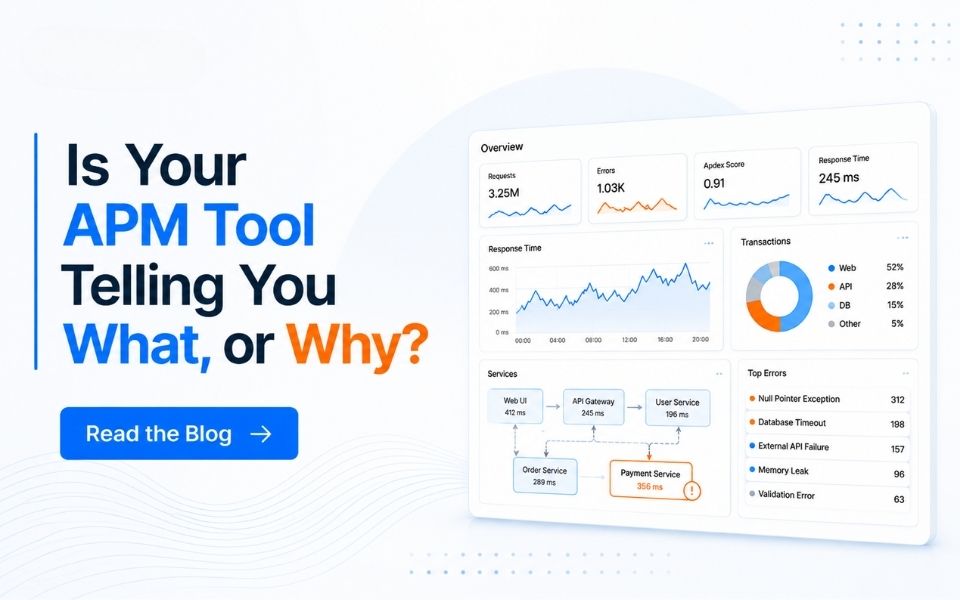
Application Performance Monitoring: The 2026 Guide to Key Metrics, Tools, and Root Cause Analysis
Modern applications rarely fail in one obvious place. A slow checkout page might trace back to a database query three services away. A spike in errors might be a downstream API silently timing out. Application…
- Sep 02
Categories
Latest Post

AI document processing: automating binder-to-policy review
- October 1, 2026


How AI Tests AI: Inside Autonomous Quality Engineering
- September 18, 2026

google-site-verification: google57baff8b2caac9d7.html

Headquarters
8845 Governors Hill Dr, Suite 201
Cincinnati, OH 45249
Our Branches
Cincinnati | Jacksonville | Indianapolis | London | Hyderabad | Bangalore | Pune
Narwal | © 2024 All rights reserved