Unlike standalone AI agents that perform isolated tasks, AI agent orchestration enables intelligent collaboration, context sharing, decision-making, and workflow execution across complex enterprise environments.
As enterprises invest in enterprise AI automation, agentic orchestration is emerging as a critical capability for scaling AI initiatives beyond individual use cases and into end-to-end business processes.
Enterprises are rapidly deploying AI agents across departments, from customer support and software development to finance and operations. But as the number of agents grows, a new challenge emerges: how do you ensure they work together effectively?
A single AI agent can automate a task. A coordinated network of agents can automate an entire business process.
This is where agentic orchestration comes in. Rather than focusing on individual agents, agentic orchestration creates the coordination layer that enables multiple agents, tools, and systems to work toward a common objective. As organizations move from AI experimentation to enterprise-scale adoption, orchestration is becoming the foundation for autonomous business operations.
Agentic orchestration enables multiple AI agents, models, tools, and enterprise systems to operate within a shared decision framework. It governs how agents collaborate, exchange context, make decisions, and execute actions across complex workflows while maintaining governance, accountability, and operational control.
The need for orchestration emerges as organizations move beyond isolated AI use cases. While individual agents can perform specific tasks effectively, enterprise processes rarely operate in isolation. Customer service, operations, finance, compliance, and technology functions are interconnected, requiring decisions and actions to flow seamlessly across systems and teams.
As enterprises scale AI adoption, orchestration is becoming a critical capability for transforming disconnected AI initiatives into intelligent, end-to-end business operations.
Why Agentic Orchestration Matters
The value of enterprise AI orchestration extends far beyond operational efficiency.
Organizations are increasingly adopting orchestration because it helps them:
- Accelerate decision-making across business functions
- Reduce manual coordination and operational costs
- Improve process consistency and compliance
- Increase workforce productivity by eliminating repetitive work
- Strengthen resilience through adaptive workflows
- Enable end-to-end automation across complex business processes
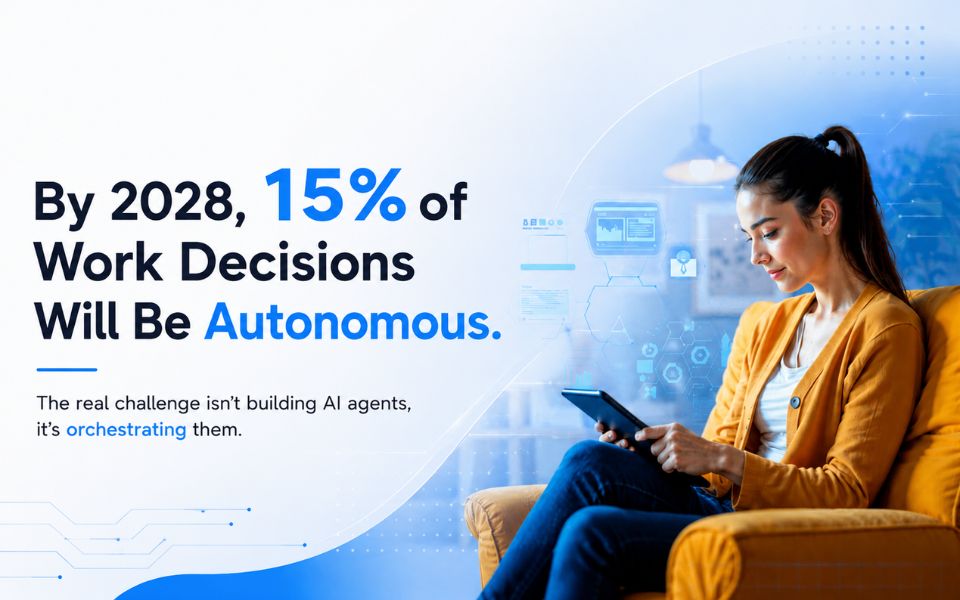
The shift is already underway. Gartner predicts that at least 15% of day-to-day work decisions will be made autonomously through agentic AI by 2028, compared with virtually none in 2024. Gartner also expects one-third of enterprise software applications to incorporate agentic AI capabilities during that same period.
Meanwhile, McKinsey research shows that while many organizations have experimented with AI agents, relatively few have successfully scaled them into production systems that deliver measurable business value. Data challenges and coordination complexity remain among the primary obstacles.
Agentic orchestration addresses these challenges by providing the governance, coordination, and execution framework required to scale AI from isolated pilots into enterprise-wide operational systems.
Agentic Orchestration in Action
Enterprises are already applying agentic orchestration to coordinate decision-making and execution across critical business processes.
Healthcare: AI agents can coordinate patient scheduling, claims processing, prior authorization workflows, and clinical documentation management.
Insurance: Multi-agent systems can automate claims processing, fraud detection, risk assessment, and policy servicing.
Banking and Financial Services: Agentic AI can streamline KYC verification, loan processing, compliance monitoring, and customer onboarding.
Retail and E-commerce: AI agents can coordinate inventory management, demand forecasting, personalized customer engagement, and order fulfillment.
IT Operations: AI agents can detect incidents, perform root cause analysis, coordinate investigations, and initiate remediation actions across infrastructure and application environments.
Finance: Orchestrated agents can manage reconciliations, monitor transactions, identify anomalies, and support regulatory reporting with minimal human intervention.
Customer Experience: Multiple agents can collaborate to personalize interactions, resolve support issues, manage escalations, and improve response times.
Software Development: AI agents can support the software development lifecycle, from planning and code generation to testing, code review, deployment validation, and monitoring.
Supply Chain and Procurement: Agents can coordinate inventory analysis, supplier evaluations, logistics planning, and procurement workflows while adapting to changing conditions in real time.
Manufacturing: Orchestrated agents can support predictive maintenance, production planning, quality assurance, and supply chain optimization.
As adoption accelerates, agentic orchestration is becoming a practical way for organizations to scale AI beyond isolated use cases and into core business operations.
Scaling Agentic Orchestration Successfully
Despite its potential, implementing an AI agent orchestration framework comes with challenges. Organizations often struggle with fragmented data, legacy systems, governance concerns, and unclear success metrics.
To improve the likelihood of success:
- Prioritize high-value workflows where outcomes are measurable and governance requirements are clearly understood
- Prioritize data quality before introducing agents
- Build governance and audit capabilities from the outset
- Define measurable success criteria early
- Focus on business outcomes rather than technology adoption
The most successful organizations view orchestration as a business transformation initiative, not simply a technology deployment.
Key Components of an Enterprise AI Orchestration Framework
Successful AI orchestration platforms typically include several foundational capabilities:
- Agent coordination and task management
- Enterprise data integration
- Context sharing across agents
- Governance and compliance controls
- Workflow monitoring and observability
- Security and access management
- Human-in-the-loop oversight mechanisms
- Performance measurement and continuous optimization
Together, these capabilities enable organizations to deploy AI agents responsibly while maintaining visibility, control, and accountability.
At Narwal, we see agentic orchestration emerging as a foundational capability for enterprises looking to move beyond AI experimentation and build production-ready, outcome-driven systems. Through our AI Accelerators, organizations can combine AI agents, enterprise data, and automation within a governed framework that supports scalability, visibility, and operational control.
The Future of Enterprise AI
Enterprise AI is moving beyond isolated assistants and point solutions toward interconnected ecosystems of collaborating agents.
As adoption grows, organizations will increasingly rely on orchestrated networks of agents that can coordinate work across departments, systems, and business processes. These systems will continuously learn, adapt, and improve while operating within clearly defined governance boundaries.
Agentic orchestration is becoming the foundation that enables enterprises to operationalize AI at scale. As autonomous systems become more capable, the ability to coordinate, govern, and align them with business objectives will become a defining competitive advantage.
The organizations that succeed will not be those with the most AI agents. They will be the ones that can orchestrate intelligence across the enterprise.
Frequently Asked Questions
Agentic orchestration is the process of coordinating multiple AI agents, tools, workflows, and decision-making systems to work together toward a shared business objective. It enables organizations to automate complex, end-to-end processes while maintaining governance, accountability, and operational control.
Traditional workflow automation relies on predefined rules and fixed process flows. Agentic orchestration is goal-driven, allowing AI agents to adapt to changing conditions, collaborate with other agents, and make decisions dynamically throughout the workflow.
Agentic orchestration helps enterprises improve operational efficiency, accelerate decision-making, reduce manual effort, enhance compliance, and scale AI initiatives across business functions. It also enables intelligent coordination between multiple AI agents, creating more resilient and adaptive workflows.
Common agentic orchestration use cases include IT operations, customer support, software development, finance, supply chain management, procurement, and business process automation. Organizations use multi-agent systems to automate workflows that require reasoning, collaboration, and real-time decision-making.
Organizations should begin with a high-value business process where outcomes are measurable and risks are manageable. Success depends on strong data foundations, clear governance policies, defined success metrics, and selecting workflows that can benefit from AI agent collaboration and automation.
Related Posts
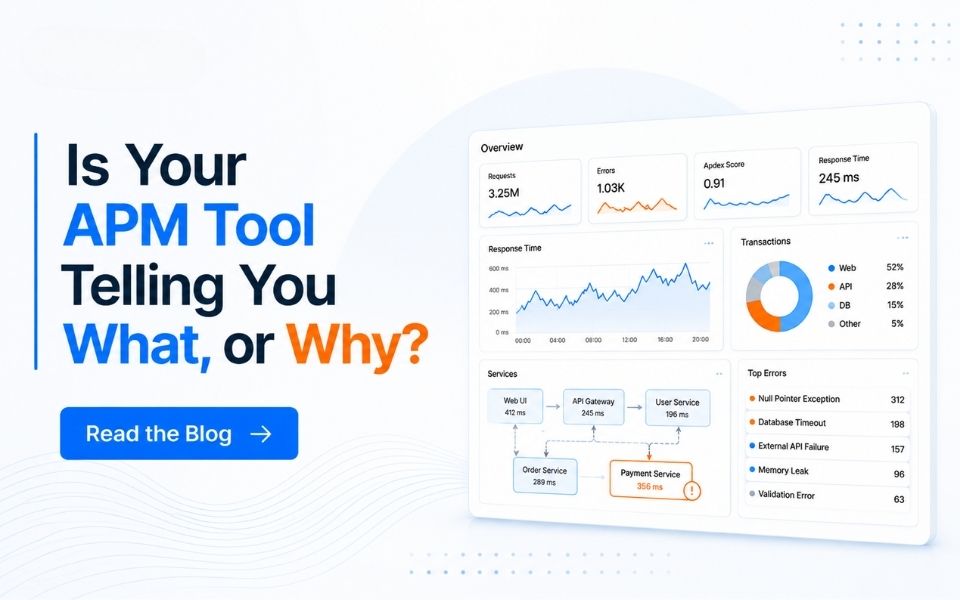
Application Performance Monitoring: The 2026 Guide to Key Metrics, Tools, and Root Cause Analysis
Modern applications rarely fail in one obvious place. A slow checkout page might trace back to a database query three services away. A spike in errors might be a downstream API silently timing out. Application…

- Sep 02

How Narwal Helped a Leading Healthcare Technology Company Build AI Observability and Governance into its AI Platform
Summary Narwal.ai helped a leading US-based healthcare technology company transform its production AI platform from a black box into a measurable enterprise system. By embedding AI observability, cost visibility, adoption analytics, and model-quality governance into…
- Aug 20


google-site-verification: google57baff8b2caac9d7.html

Headquarters
8845 Governors Hill Dr, Suite 201
Cincinnati, OH 45249
Our Branches
Cincinnati | Jacksonville | Indianapolis | London | Hyderabad | Bangalore | Pune
Narwal | © 2024 All rights reserved