
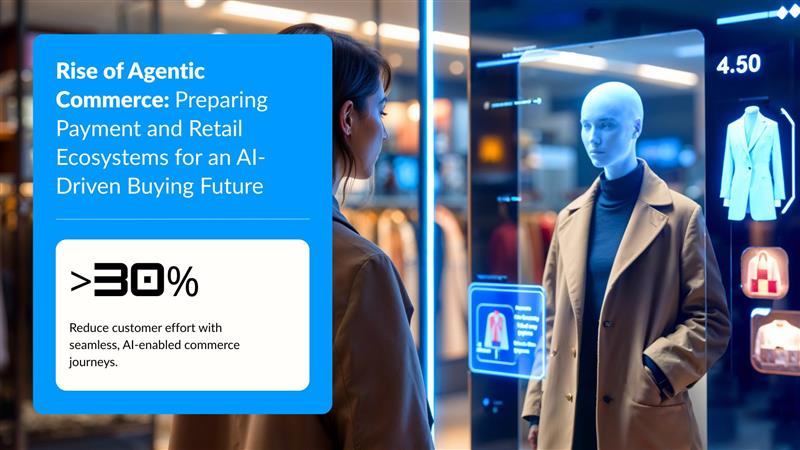
Digital commerce is entering a transformative phase where transactions are no longer driven solely by human interactions. Intelligent AI agents are beginning to act on behalf of consumers anticipating needs, evaluating options across platforms, negotiating value, and completing purchases with minimal friction.
This emerging paradigm, known as Agentic Commerce, represents a fundamental shift in how customers discover products, engage with brands, and complete transactions. For payments providers, retailers, marketplaces, and ecosystem partners, the rise of AI-mediated buying journeys introduces both unprecedented opportunity and strategic urgency. Organizations that proactively prepare can unlock higher conversion efficiency, deeper personalization, and new monetization models, while those that delay risk losing visibility and relevance in an increasingly autonomous commerce landscape.
Industry research reinforces the scale of this shift. Gartner highlights that by 2028, more than 33% of enterprise software applications will include agentic AI capabilities, fundamentally reshaping digital interaction models. At the same time, McKinsey notes that advanced personalization and AI-driven engagement strategies have enabled leading digital commerce organizations to achieve revenue uplifts of approximately 12% and customer satisfaction improvements of 18%.
These signals point to a clear conclusion: AI-mediated commerce is not experimental it is becoming a strategic imperative.
From Click-Driven Journeys to Intent-Driven Experiences
Traditional e-commerce journeys are fragmented and time-intensive. Consumers navigate multiple applications, compare pricing manually, coordinate logistics independently, and resolve post-purchase issues through disconnected support channels.
Agentic commerce reimagines this experience entirely. Autonomous AI agents act as digital decision engines synthesizing context, learning user preferences, and executing multistep workflows aligned with intent.
Consider a common life event such as relocating to a new city. Activities that typically require hours of coordination researching housing options, reselling existing assets, purchasing furniture, arranging delivery schedules, and managing support interactions can be orchestrated seamlessly by an intelligent agent. By interpreting budget constraints, commute requirements, lifestyle preferences, and family needs, the agent can curate options, negotiate transactions, and synchronize logistics.
This shift represents the evolution of commerce from interface-centric engagement to intent-centric ecosystems, where intelligent agents increasingly become the primary drivers of discovery and conversion.
Reimagining the End-to-End Customer Journey
An agentic commerce journey introduces a new operational flow:
- Proactive identification of purchase needs based on behavioral signals or contextual triggers
- Intelligent product discovery leveraging preferences, reviews, pricing signals, and delivery timelines
- Automated comparison of offers and direct negotiation with merchant platforms
- Curated recommendation shortlists enabling faster decision cycles
- Autonomous checkout using stored payment credentials, loyalty benefits, and delivery configurations
- Continuous monitoring of fulfillment with proactive management of returns, refunds, or support issues
Digital commerce benchmarks indicate that optimizing these lifecycle touchpoints can reduce customer effort by 34% and improve digital experience satisfaction scores by 22%, directly influencing long-term retention and lifetime value.
New Interaction Models in Autonomous Commerce
As agentic commerce evolves, organizations will increasingly operate across multiple interaction models:
Agent-to-Site interactions
Consumer agents navigate merchant platforms directly to evaluate offerings and execute transactions.
Agent-to-Agent ecosystems
Dedicated merchant agents negotiate with consumer agents to enable dynamic pricing, bundled offers, and contextual promotions.
Brokered orchestration layers
Intermediary agent frameworks coordinate complex multi-party journeys involving marketplaces, logistics providers, loyalty platforms, and payment networks.
These models enable enterprises to leverage existing digital investments while progressively unlocking autonomous commerce capabilities at scale.
Strategic Imperatives for Payments Leaders in an Agent-Mediated Economy
The shift toward agentic commerce is particularly transformative for payments providers, who sit at the center of transaction orchestration and trust enablement.
To remain competitive, payments ecosystem players must prioritize:
- Enabling agent-compatible payment authorization flows that support autonomous checkout and contextual identity validation
- Modernizing fraud intelligence and risk scoring frameworks to operate effectively in AI-to-AI transaction environments
- Building programmable loyalty and tokenized value mechanisms that agents can interpret and optimize dynamically
- Supporting real-time payment orchestration and transparent settlement frameworks across platforms and geographies
Organizations investing in intelligent payment orchestration capabilities have reported operational efficiency improvements of 27% and product rollout acceleration of 19%, strengthening their ability to innovate in rapidly evolving commerce ecosystems.
Building Knowledge Readiness for the Agentic Economy
While the promise of agentic commerce is compelling, many enterprises face a foundational readiness challenge fragmented institutional knowledge spread across policy frameworks, protocol standards, compliance guidelines, and strategic initiatives.
Innovation programs often slow due to limited visibility into emerging architectural requirements and ecosystem implications. Establishing a structured knowledge intelligence layer becomes critical to accelerating decision-making and execution.
Narwal’s Knowledge QnA, powered by agentic retrieval-augmented intelligence and intelligent document processing, helps organizations transform complex documentation into actionable enterprise insights.
By enabling conversational access to strategic content, protocol interpretation, risk guidance, and operational frameworks, Knowledge QnA empowers cross-functional teams across payments, product, compliance, and engineering to align faster and innovate with confidence.
Enterprises implementing knowledge intelligence platforms have demonstrated measurable outcomes, including:
- Reduction of strategy and architecture decision cycles by 41%
- Improvement in research productivity for emerging payment standards by 58%
- Acceleration of audit and compliance readiness response by 36%
- Faster execution of digital commerce innovation initiatives by 29%
These outcomes create a scalable foundation for downstream AI adoption across fraud prevention, transaction forecasting, quality engineering, and data-driven customer engagement platforms.
Leading the Future of Autonomous Commerce with Narwal
Agentic commerce is rapidly becoming a defining force in the evolution of digital transactions. As intelligent agents increasingly act as intermediaries between consumers and brands, enterprises must build the technology, knowledge, and governance foundations required to remain competitive.
At Narwal, we help payments providers, retailers, and commerce ecosystem leaders prepare for this shift by enabling agent-compatible architectures, knowledge intelligence platforms, and AI-driven data and quality engineering frameworks.
From agentic commerce readiness assessments to secure payment workflow transformation and enterprise AI implementation, Narwal partners with organizations to accelerate innovation while ensuring trust, performance, and measurable business outcomes.
Resources
- Gartner, Top Strategic Technology Trends – Agentic AI and Autonomous Systems, 2024–2025 insights on AI-driven enterprise applications
- McKinsey Global Institute, The Economic Potential of Generative AI, 2023 — analysis on AI-led productivity and innovation acceleration
- World Economic Forum, Future of Digital Economy and Value Creation insights on AI, platform ecosystems, and trust frameworks
Related Posts
Generative AI : Enabling Intelligent Automation and Enterprise Innovation
Generative AI is rapidly transforming how enterprises innovate, automate, and deliver value. From intelligent virtual assistants to autonomous workflow orchestration, Generative AI is enabling organizations to move beyond traditional analytics and automation toward context-aware, adaptive, and scalable decision-making systems. As…

- Mar 27
How Enterprises Are Leveraging the Best AI Agents to Power Decision Intelligence
Artificial intelligence is entering a new phase of evolution. While generative AI initially transformed how organizations create content, write code, and analyze information, the next wave of innovation is centered around intelligent autonomous systems known as AI agents. These…
- Mar 06
Categories
Latest Post


google-site-verification: google57baff8b2caac9d7.html

Headquarters
8845 Governors Hill Dr, Suite 201
Cincinnati, OH 45249
Our Branches
Cincinnati | Jacksonville | Indianapolis | London | Hyderabad | Bangalore | Pune
Narwal | © 2024 All rights reserved