
How AI Is Rewiring Software, Data, Security, and Business Decision-Making
Artificial Intelligence is no longer operating at the edges of enterprise systems. It is steadily moving closer to the core of how software is built, data is interpreted, risks are managed, and decisions are made.
Over the last few years, most enterprises experimented with AI through pilots, copilots, and isolated use cases. Those efforts helped teams understand potential, but they were built around AI as an add-on. That assumption is now breaking down.
Today’s enterprise landscape is interconnected, real time, and increasingly autonomous. Software systems evolve continuously, data volumes are exploding, and business decisions are expected at machine speed. In this world, AI cannot sit outside workflows. It must be embedded directly into how work gets done.
As we look toward 2026 and beyond, AI will move from experimentation to execution. Based on what I see across large enterprise programs, five AI-driven shifts will define where intelligence delivers the fastest growth and the highest impact.
AI for Development: Intelligence Across the SDLC
AI in software development has moved far beyond code suggestions.
Gartner estimates that by 2026, over 70% of enterprise software teams will use AI-assisted development tools across multiple SDLC stages, not just coding. The real shift is happening in requirements analysis, test generation, defect prediction, and release readiness.
When AI operates across the lifecycle, it reduces rework and surfaces risk earlier. McKinsey research shows that organizations applying AI across engineering workflows can improve developer productivity by 20–45%, primarily by reducing downstream rework.
The SDLC begins to behave less like a linear pipeline and more like a learning system. Teams that redesign the SDLC assuming intelligence at every stage will move faster without sacrificing stability.
AI for Data: From Pipelines to Self-Learning Knowledge Layers
Traditional data platforms were designed to move and store data efficiently. That model is no longer sufficient.
According to Gartner, by 2027, more than 60% of enterprises will augment data platforms with semantic layers such as knowledge graphs / databases to support GenAI, analytics, and automation. These layers capture relationships, context, and meaning, not just records.
Self-learning knowledge graphs and knowledge databases continuously improve based on usage patterns and outcomes. This allows AI systems to reason over data rather than simply retrieve it. Without intelligent data layers, AI initiatives stall. With them, data stops being reactive and starts actively informing decisions across the enterprise.
AI for Business: Knowledge QnA and Intelligent Document Processing
AI is increasingly becoming the interface between people and enterprise knowledge.
Forrester estimates that by 2026, over 50% of enterprise knowledge work will involve conversational AI or intelligent document processing. The fastest adoption is happening in functions dealing with contracts, policies, invoices, claims, and operational documents.
The value is not just automation. It is accessibility and consistency. Business users no longer need to understand systems or schemas. They ask questions, receive answers, and trigger actions.
As AI matures, business intelligence shifts from dashboards to dialogue.
AI for Security Operations: From Alerts to Agentic Response
Security operations are undergoing one of the most urgent AI-driven transformations.
Gartner reports that SOC teams today ignore or manually suppress over 60% of alerts due to volume and noise. AI is being applied to fraud detection, alert correlation, and intelligent routing to focus attention on real threats.
What changes the game is the rise of agentic AI protocols. Frameworks such as LangGraph, MCP, ACP and agent-to-agent (A2A) communication models allow AI agents to coordinate investigations and responses dynamically.
Gartner predicts that AI-assisted SOC platforms will reduce incident response times by up to 50%, shifting security from reactive monitoring to adaptive defense.
AI for Forecasting: From Historical Analysis to Real-Time Prediction
Forecasting is one of the clearest examples of AI delivering immediate business value. McKinsey analysis shows that AI-driven forecasting models can improve prediction accuracy by 10–20% across domains such as cash flow, energy demand, and payments. More importantly, they update continuously as conditions change.
This allows organizations to move from static planning cycles to dynamic, real-time decision-making. Forecasting becomes an operational capability rather than a quarterly exercise.
In volatile markets, this shift directly impacts liquidity, risk exposure, and operational resilience.
A Closing Thought
Across development, data, business operations, security, and forecasting, one message is consistent. AI is moving closer to execution.
The next phase of enterprise AI will not be defined by how advanced the models are, but by how deeply intelligence is embedded into workflows, platforms, and decision systems. AI that sits outside the system creates insight. AI that sits inside the system creates outcomes.
As enterprises move forward, the question is no longer where AI can be added, but where intelligence truly belongs.
At Narwal.ai, we help enterprises move AI from pilots to production by embedding intelligence across engineering, data, security, and business workflows. Our AI services focus on building scalable, governed, and outcome-driven systems that deliver real-world impact at enterprise scale.
About the Author

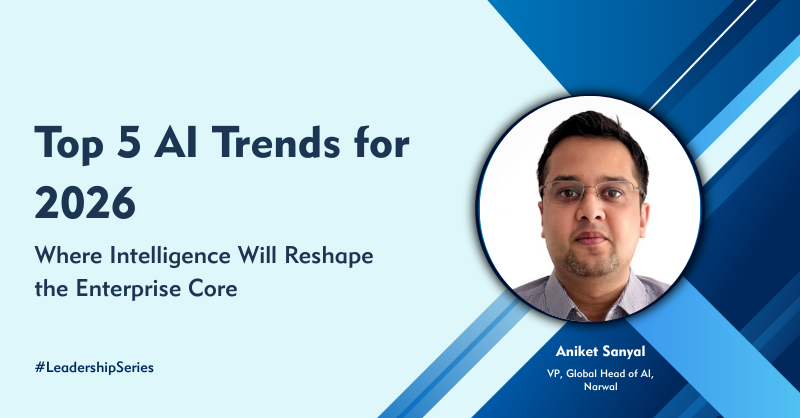
Aniket Saniyal
VP & Global Head of AI, Narwal
With deep experience at the intersection of AI, data platforms, and enterprise systems, Aniket focuses on applying AI pragmatically across software development, data intelligence, business operations, security workflows, and forecasting to deliver scalable, real-world outcomes.
References and Resources
Gartner Strategic Predictions for 2026
Forrester Research on AI in Software Development and Data Platforms
McKinsey & Company AI and Analytics Insights
Related Posts

Top 7 Data Trends for 2026: Redefining Data Engineering, Monetization, and Transformation
By Sachin Kumar, VP & Head of Data January 2026 Enterprise data is no longer a passive asset waiting to be queried. It is becoming active, autonomous, and increasingly responsible for driving decisions at machine speed. …
- Jan 19

Beyond the AI Hype: Why Snowflake Openflow, Not Traditional ETL, Defines the Next Data Era
69% of organizations claim to have a data strategy, and 66% believe they have an AI strategy, as highlighted by Forrester’s Data and Analytics Survey for 2025. Yet despite this confidence, most enterprises are still…
- Dec 22
google-site-verification: google57baff8b2caac9d7.html
Headquarters
8845 Governors Hill Dr, Suite 201
Cincinnati, OH 45249
Our Branches
Cincinnati | Jacksonville | Indianapolis | London | Hyderabad | Bangalore | Pune
Narwal | © 2024 All rights reserved