
- Quality Engineering Blog
- Oct 08
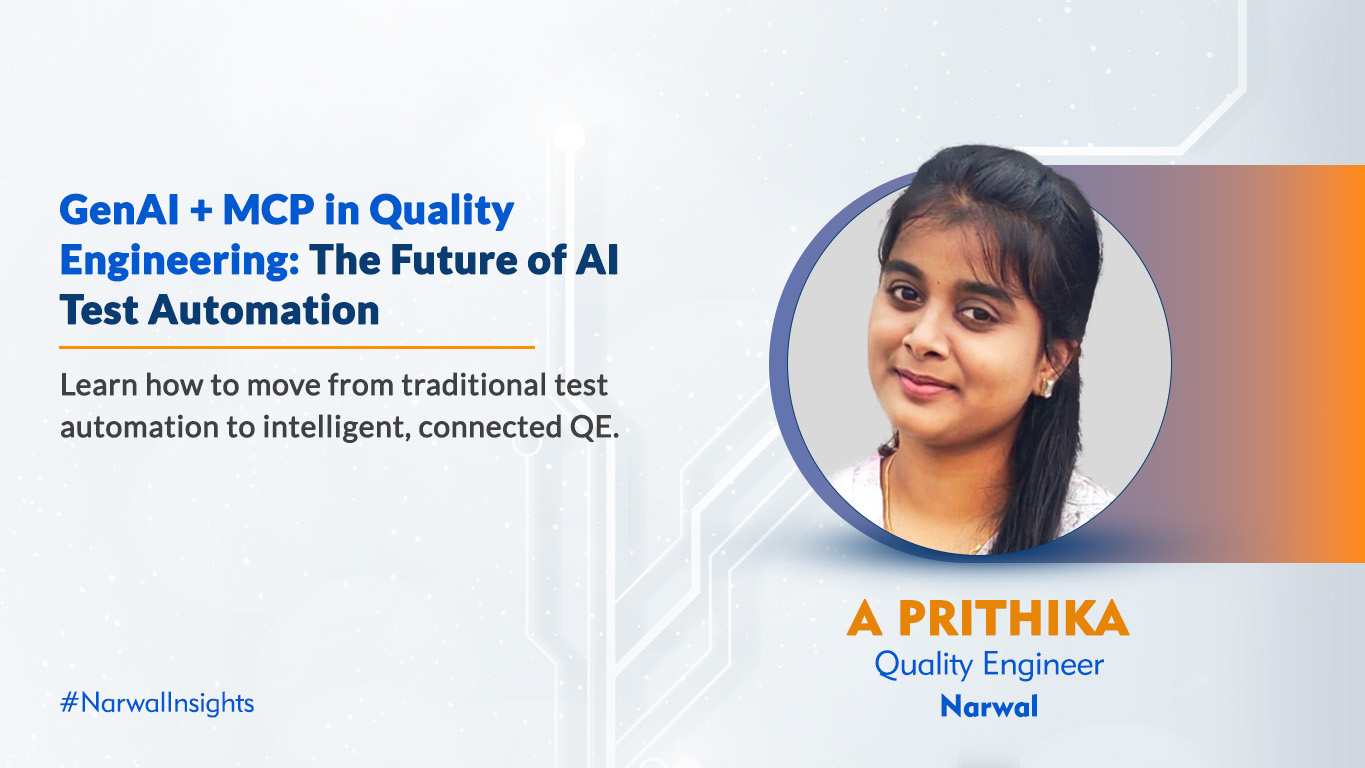
GenAI + MCP in Quality Engineering: The Future of AI Test Automation
Introduction
AI test automation is helping teams accelerate software testing, but traditional automation still has clear limitations. Scripts take time to write and can break when applications change. Maintenance consumes the hours automation was meant to save, while requirements, test management, CI/CD, and defect-tracking tools often remain disconnected.
Two developments are changing this. Generative AI (GenAI) can understand requirements, write tests, generate data, and reason for failures. Model Context Protocol (MCP) is an open standard that lets AI agents connect to external tools and data in a consistent way.
GenAI supplies intelligence, and MCP supplies connectivity. Used together, they move automation from scripted execution toward an intelligent workflow that spans the whole quality lifecycle.
Why Traditional Test Automation Is Reaching Its Limits
- High creation effort. Every test is handwritten, which slows coverage growth.
- Brittle maintenance. UI and API changes break scripts, and teams spend significant time repairing them.
- Siloed tools. Insights live in separate systems, and people manually carry context between them.
- Slow triage. Analyzing failures means gathering logs, code changes, and history from several places.
- Limited adaptability. Scripts do exactly what they were told, nothing more.
GenAI and MCP: Two Building Blocks of AI-Powered QE
GenAI: the intelligence
Large language models and related GenAI techniques can:
- Interpret natural-language requirements and user stories
- Generate test cases, automation scripts and test data
- Analyze logs, screenshots and failure patterns
- Summarize results and explain them in plain language
- Suggest fixes when tests or locators break
MCP: the connectivity
MCP gives AI agents a standard way to discover and use tools. It has three parts:
- MCP servers expose a tool’s capabilities, such as “fetch a requirement” or “trigger a pipeline.”
- MCP clients are the AI agents or applications that use those capabilities.
- Tools, resources, and prompts are the actions, data, and reusable instructions a server provides.
A GenAI model can reason over the information provided to it, but MCP gives an AI application a standardized way to interact with external tools, systems, and data. Connected through MCP, an AI application can read Jira stories, retrieve test data, trigger CI runs, and create defect tickets through the tools and systems exposed to it.
How GenAI and MCP Transform the Testing Lifecycle
Requirement analysis and test design
A GenAI agent reads a user story through an MCP server connected to your project management tool. It checks existing coverage in the test management system, identifies gaps and drafts new test cases, including positive, negative and edge scenarios. A QE reviews and approves them before they are saved.
Automation script generation
Once test cases are approved, GenAI converts them into automation scripts in your chosen framework, following your team’s coding standards. It commits the code to source control through an MCP connection, ready for review.
Synthetic test data
GenAI generates realistic, varied test data that respects format rules and privacy requirements. This avoids copying sensitive production data while still covering the combinations testers need.
Intelligent execution
When a pull request is raised, the agent inspects the code change, selects the relevant tests, and triggers the pipeline through the CI/CD MCP server. It prioritizes high-risk areas rather than blindly running everything.
Self-healing automation
When a test fails because a locator or element changes, GenAI analyzes the page or response, proposes an updated locator and either applies it under governance rules or raises it for review. This reduces the maintenance burden.
Failure triage and root cause analysis
The agent gathers logs, screenshots, recent commits and historical failures from several tools through MCP. GenAI then classifies the failure as a real defect, a flaky test, an environment problem or a data issue, and explains its reasoning.
Defect reporting
For confirmed defects, GenAI writes a clear report with reproduction steps, evidence and affected components, and creates the ticket in your defect tracker, linked to the related requirement and test.
Release readiness reporting
A QE lead ask, “How ready is this release?” The agent pulls coverage, pass rates, open defects and risk areas across tools, and GenAI summarizes them in plain language with recommendations.
Benefits of AI-Powered Quality Engineering
- Broader coverage, faster. GenAI accelerates test design and script creation.
- Lower maintenance effort. Self-healing and automated triage reduce repetitive repair work.
- Less integration work. Standardized MCP interfaces can reduce the integration effort required to connect AI applications with enterprise tools.
- You can change AI models or tools without rebuilding the whole workflow.
- Richer context. Agents working with live, cross-tool data give more relevant results than those working from isolated snippets.
- Higher-value QE roles. Engineers spend less time on repetitive scripting and more on strategy, risk analysis, and evaluation.
Risks and Governance Considerations
Hallucinated or low-quality tests
GenAI can produce tests that look right but assert the wrong thing. Mitigation: human review of generated tests, validation against requirements, and tracking of defect-detection effectiveness.
Over-permissioned agents
An agent that can trigger deployments or delete assets can cause serious harm. Mitigation: least-privilege access, read-only by default and separate credentials per agent.
Prompt injection through test artifacts
Logs, defect descriptions and requirement text can hide malicious instructions. Mitigation: treat tool output as untrusted, limit actions after reading external content and require approval for sensitive steps.
Unvetted MCP servers
A poorly built or malicious server can leak data or misrepresent a tool. Mitigation: maintain an approved catalog, review permissions and pin versions.
Sensitive data exposure
Test environments often hold production-like data. Mitigation: mask or synthesize data and enforce data boundaries.
Weak traceability
Mitigation: Log every tool call with inputs, outputs, timestamps, and agent identity.
Testing the GenAI and MCP Layer
Teams adopting this approach must test it too:
- Contract testing to confirm each MCP server behaves as described
- Evaluation of generated output for test quality, coverage relevance and script correctness
- Tool-selection testing to check the agent picks the right tool and parameters
- Failure testing for timeouts, malformed responses and unavailable servers
- Security testing, including prompt injection and permission boundary checks
- Regression testing whenever a model, prompt, server or tool schema changes
This raises a bigger question. If AI agents are designing tests, acting across tools and talking to customers and employees, who validates the AI itself? Manually scripted tests can’t keep pace with systems that behave differently each time. That is the thinking behind Narwal’s approach.
How to Start with AI-Powered Quality Engineering
Organizations can begin their AI-powered Quality Engineering journey incrementally rather than transforming the entire testing ecosystem at once:
- Start with one high-value workflow. Choose a focused use case, such as test case generation, failure triage, or release readiness analysis, where AI can deliver measurable value.
- Begin with read-only access. Give the AI application access to the information it needs while keeping actions controlled. Introduce write permissions only after the workflow has been validated.
- Connect two or three systems. Use MCP to connect the AI workflow with essential tools such as requirements, test management, CI/CD, or defect tracking systems.
- Measure the impact. Track metrics such as test creation time, maintenance effort, failure triage time, test coverage, and overall QE efficiency to demonstrate value and guide the next phase of adoption.
Narwal’s Vision for Autonomous Quality Engineering
Traditional QE validates deterministic software. AI applications introduce a different challenge: non-deterministic behavior, evolving models, prompt injection, hallucinations, guardrail failures and context-dependent responses. This requires Quality Engineering that can continuously evaluate the AI system not simply execute predefined scripts.
Our approach combines decades of Quality Engineering expertise with AI-powered validation techniques to help organizations confidently scale Generative AI initiatives.
To bring this vision to life, Narwal has developed AIRA (Autonomous Intelligent Risk Assessment), an AI-powered platform designed to autonomously validate conversational AI systems.
Instead of relying solely on manually scripted tests, AIRA intelligently explores AI behavior, evaluates responses across critical quality dimensions, identifies vulnerabilities, and provides actionable recommendations to improve trust, security, and reliability.
Narwal Solutions for AI-Powered QE
- NAX (Narwal Automation FrameworkX): a unified, AI-powered automation framework that works across tools such as Selenium, Playwright and Cypress, with self-healing support to reduce script maintenance.
- NILA (Narwal Intelligent Lifecycle Assurance): a GenAI-powered QE platform that brings AI into stages such as user story refinement, script generation and synthetic test data creation.
- Narwal AI Accelerators: a portfolio of reusable, ready-to-adopt accelerators that help enterprises move AI initiatives from pilot to production faster.
The Future of Autonomous Quality Engineering
The future of enterprise software will increasingly be shaped by autonomous AI agents capable of making recommendations, executing workflows, and interacting directly with customers and employees.
As AI becomes more autonomous, Quality Engineering must evolve alongside it. Testing every possible scenario manually is no longer feasible. Instead, organizations need intelligent systems capable of continuously challenging AI, validating behavior, and safeguarding trust.
GenAI makes test automation smarter, and MCP makes it connected. Autonomous Quality Engineering makes sure both can be trusted. It is not merely the next phase of test automation; it is a new discipline built for the realities of the AI era.
See Autonomous QE in Action
As AI applications become more capable and less predictable, traditional scripted testing alone cannot provide the coverage and continuous validation they require. Autonomous Quality Engineering enables AI systems to be tested dynamically across real-world scenarios, helping teams identify behavioral, security, and reliability risks earlier.
Join Narwal’s upcoming webinar, When AI Tests AI: Autonomous QE for LLM Chatbots, to explore how AI-powered agents can autonomously test LLM-based applications, uncover critical vulnerabilities, and strengthen trust in AI systems.
12 November 2026 | 9:30 PM–10:30 PM IST | 11:00 AM–12:00 PM ET
About the Author
A Prithika
Quality Engineer, Narwal
A Prithika is a Quality Engineer at Narwal, with a focus on Quality Engineering, test automation, and emerging AI-driven approaches to software quality.
Frequently Asked Questions
GenAI in Quality Engineering uses generative AI to assist with activities such as test design, test automation, synthetic test data generation, failure analysis, defect reporting and release readiness assessment.
Model Context Protocol (MCP) provides a standardized way for AI applications to interact with external tools, systems and data. In testing environments, this can connect AI agents with requirements, test management, CI/CD, source control and defect management systems.
MCP can give AI applications structured access to the tools and context required to perform testing workflows across enterprise systems, reducing the need for point-to-point integrations.
Autonomous Quality Engineering extends traditional automation by using AI to reason about testing activities, adapt to changing conditions, analyze results and continuously evaluate software quality.
No. GenAI can automate and accelerate repetitive QE activities, but human oversight remains important for validating requirements, reviewing generated tests, managing risk and making quality decisions.
Organizations can begin with a focused workflow such as test generation or failure triage, connect a limited number of tools, start with controlled permissions, and measure outcomes before expanding the approach.
Related Posts
Beyond Test Automation: The Rise of Autonomous Quality Engineering in the AI Era
Why traditional QA is reaching its limits, and how Autonomous Quality Engineering is redefining software quality for the age of Generative AI. Artificial Intelligence has fundamentally changed how software is built, delivered, and experienced. Across…

- Sep 24
How AI Tests AI: Inside Autonomous Quality Engineering
From scripted automation to intelligent validation, how autonomous agents are transforming Quality Engineering for enterprise AI. In the first article of this series, I explored why traditional Quality Engineering struggles to keep pace with Generative…
- Sep 18
Categories
Latest Post


AI document processing: automating binder-to-policy review
- October 1, 2026


How AI Tests AI: Inside Autonomous Quality Engineering
- September 18, 2026
google-site-verification: google57baff8b2caac9d7.html

Headquarters
8845 Governors Hill Dr, Suite 201
Cincinnati, OH 45249
Our Branches
Cincinnati | Jacksonville | Indianapolis | London | Hyderabad | Bangalore | Pune
Narwal | © 2024 All rights reserved