- Quality Engineering Blog
- Sep 24
Beyond Test Automation: The Rise of Autonomous Quality Engineering in the AI Era
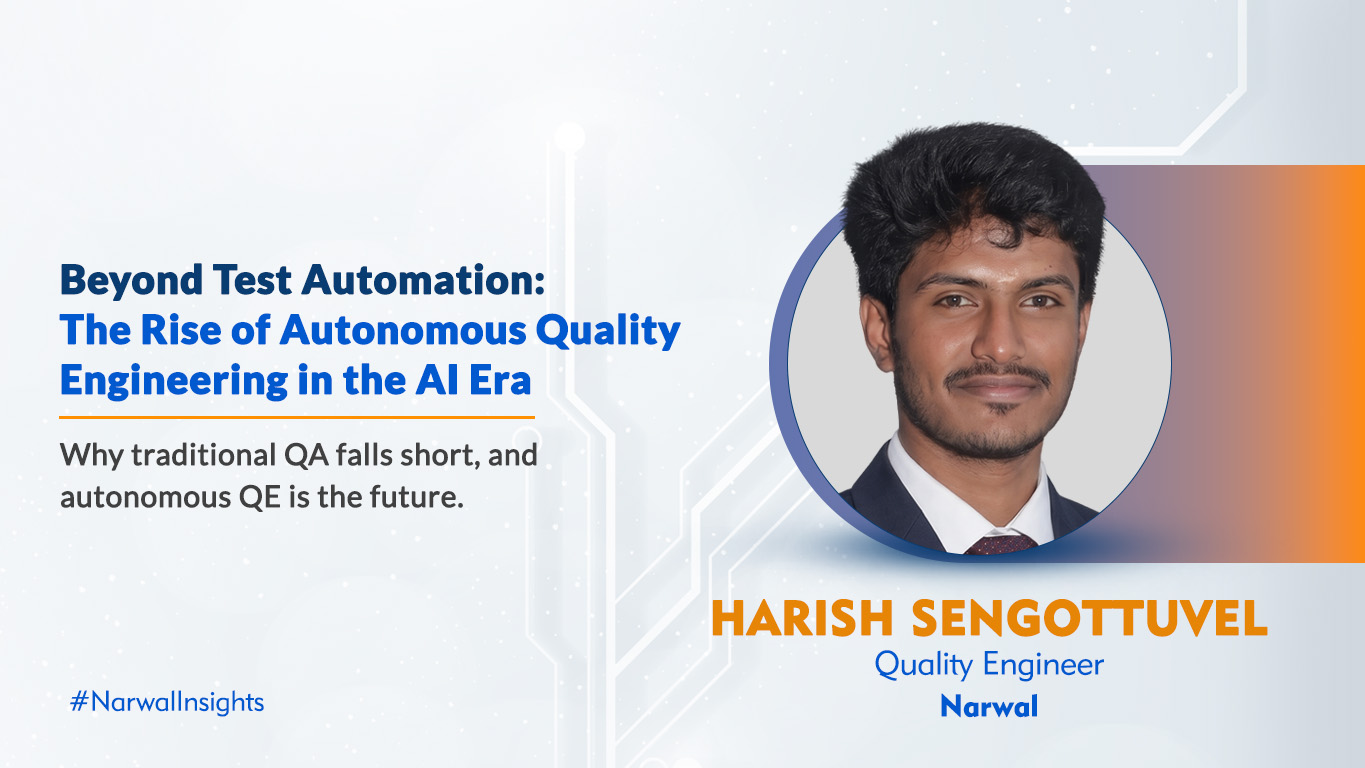
Why traditional QA is reaching its limits, and how Autonomous Quality Engineering is redefining software quality for the age of Generative AI.
Artificial Intelligence has fundamentally changed how software is built, delivered, and experienced. Across industries, organizations are embedding Large Language Models (LLMs) into customer service platforms, enterprise knowledge assistants, developer copilots, employee helpdesks, and business workflows. AI is no longer an experimental capability, it is becoming a core component of enterprise operations.
While the industry has largely focused on accelerating AI adoption, another equally important question has emerged:
How do we ensure these AI systems are reliable, secure, compliant, and trustworthy?
For decades, Quality Engineering has been built around deterministic software applications where identical inputs consistently produce identical outputs. Test automation, regression suites, and scripted validations have served organizations well because software behaved predictably.
Generative AI changes that assumption entirely.
LLMs interpret context, generate probabilistic responses, and continuously adapt to user interactions. The same prompt may produce different but equally plausible answers. This dynamic behavior introduces a new class of quality challenges that traditional testing approaches simply weren’t designed to address.
As enterprises move from AI experimentation to enterprise-scale deployment, Quality Engineering must evolve beyond automation. It must become autonomous.
The End of Deterministic Testing
Traditional software testing is based on certainty. Quality engineers define expected outcomes, automate test cases, execute regressions, and verify that applications behave exactly as intended. If functionality changes, the tests are updated accordingly.
Generative AI doesn’t operate this way. Unlike rule-based systems, LLMs generate responses based on probability rather than fixed logic. They interpret user intent, remember conversational context, and continuously produce unique outputs.
This doesn’t mean AI is unreliable; it means quality must be evaluated differently. Success is no longer measured by asking, “Did the application return the expected result?”
Instead, organizations must ask:
- Is the response accurate?
- Is it safe?
- Does it comply with business policies?
- Can it be manipulated?
- Does it remain consistent?
- Can users trust it?
These questions extend far beyond functional testing.
Why Traditional Test Automation Isn’t Enough
Conventional automation excels at validating predefined workflows. It does not excel at validating intelligent behavior. Enterprise AI introduces challenges that scripted automation cannot realistically scale to address. Consider an AI-powered customer support assistant.
Even if every business workflow functions correctly, several critical risks remain:
- Can users bypass system instructions through prompt injection?
- Will the chatbot expose confidential information?
- Does it hallucinate when it lacks context?
- Will it recommend competitors against company policy?
- Can it maintain context throughout a multi-turn conversation?
- Will different users receive contradictory responses for the same question?
- Does it stay within its intended domain?
The number of possible conversations is virtually infinite. Writing and maintaining manual test cases for every scenario quickly becomes impractical. This is precisely where traditional Quality Engineering reaches its limits.
AI Introduces an Entirely New Quality Risk Landscape
Unlike conventional applications, AI systems continuously evolve through model updates, prompt engineering, retrieval mechanisms, and business context. This creates quality risks that are dynamic rather than static.
Prompt Injection & Jailbreaks
Malicious or cleverly crafted prompts can manipulate AI into ignoring instructions, revealing sensitive information, or performing unintended actions.
Hallucinations
LLMs may confidently generate inaccurate information when they lack sufficient knowledge or context.
Sensitive Data Exposure
Without proper validation, AI assistants may inadvertently expose confidential information, customer records, or proprietary knowledge.
Context Loss
Long conversations can lead to forgotten instructions, inconsistent recommendations, or fabricated responses.
Business Policy Violations
Enterprise AI must align with organizational policies, compliance requirements, and brand guidelines not merely answer questions correctly.
Inconsistent Experiences
Users asking similar questions in different ways should receive reliable and consistent outcomes, not conflicting guidance. These are not traditional software defects. They are behavioral risks that require continuous validation throughout the AI lifecycle.
The Shift from Test Automation to Autonomous Quality Engineering
The next evolution of Quality Engineering is not simply writing more automation scripts. It is enabling intelligent systems to test intelligent systems.
Autonomous Quality Engineering combines AI, intelligent agents, and advanced validation frameworks to continuously evaluate AI behavior without relying entirely on manually scripted test cases.
Rather than executing predefined scenarios, autonomous testing agents can:
- Understand the purpose of an AI application
- Generate meaningful test scenarios dynamically
- Simulate real-world user interactions
- Explore unexpected conversational paths
- Detect vulnerabilities and policy violations
- Evaluate behavioral consistency
- Produce actionable insights automatically
The focus shifts from validating functionality to validating trust.
Defining AI Quality Beyond Functional Testing
Enterprise AI requires a broader definition of quality. At Narwal, we believe trustworthy AI must be evaluated across multiple behavioral dimensions, including:
- Accuracy – Does the AI generate reliable and factually correct responses?
- Consistency – Does it respond consistently across similar prompts?
- Guardrails – Can it resist prompt injection, jailbreaks, and role manipulation?
- Security – Does it protect confidential and sensitive information?
- Context Awareness – Can it maintain context throughout complex conversations?
- Boundary Handling – Does it remain within its intended business scope?
- Policy Compliance – Does every response align with organizational and regulatory requirements?
Together, these dimensions create a comprehensive framework for evaluating enterprise AI not just as software, but as an intelligent business capability.
From Theory to Practice
As organizations deploy AI across customer support, financial services, healthcare, retail, telecommunications, and internal operations, quality assurance can no longer be treated as a one-time activity before production.
- AI models evolve.
- Knowledge bases change.
- Prompts become more sophisticated.
- Attack vectors continue to emerge.
Quality validation must therefore become continuous, adaptive, and intelligent.
This is where Autonomous Quality Engineering delivers measurable value, helping organizations identify behavioral risks before they impact customers, employees, or business outcomes.
Narwal’s Vision for Autonomous Quality Engineering
At Narwal, we believe Autonomous Quality Engineering is the next frontier of enterprise software quality.
Our approach combines decades of Quality Engineering expertise with AI-powered validation techniques to help organizations confidently scale Generative AI initiatives.
To bring this vision to life, Narwal has developed AIRA (Autonomous Intelligent Risk Assessment), an AI-powered platform designed to autonomously validate conversational AI systems.
Instead of relying solely on manually scripted tests, AIRA intelligently explores AI behavior, evaluates responses across critical quality dimensions, identifies vulnerabilities, and provides actionable recommendations to improve trust, security, and reliability.
Whether organizations are deploying customer support bots, enterprise copilots, HR assistants, knowledge agents, or industry-specific AI solutions, Autonomous QE provides the confidence needed to accelerate adoption while reducing operational risk.
Looking Ahead
The future of enterprise software will increasingly be shaped by autonomous AI agents capable of making recommendations, executing workflows, and interacting directly with customers and employees.
As AI becomes more autonomous, Quality Engineering must evolve alongside it. Testing every possible scenario manually is no longer feasible. Instead, organizations need intelligent systems capable of continuously challenging AI, validating behavior, and safeguarding trust.
Autonomous Quality Engineering represents that evolution. It is not merely the next phase of test automation, it is a new discipline built for the realities of the AI era.
The organizations that embrace this shift today will be the ones best positioned to build trustworthy, resilient, and enterprise-ready AI tomorrow.
Discover how Narwal’s Autonomous Quality Engineering approach and AIRA help organizations continuously test, secure, and improve AI applications across accuracy, guardrails, security, and compliance. Connect with our experts to schedule an Autonomous AI Quality Assessment.
About the Author
Harish Sengottuvel
Quality Engineer, Narwal
Harish Sengottuvel is a Quality Engineer at Narwal specializing in test automation and AI-driven Quality Engineering. He is passionate about exploring modern testing strategies that help enterprises build trustworthy, resilient, and scalable AI applications.
Related Posts
How AI Tests AI: Inside Autonomous Quality Engineering
From scripted automation to intelligent validation, how autonomous agents are transforming Quality Engineering for enterprise AI. In the first article of this series, I explored why traditional Quality Engineering struggles to keep pace with Generative…

- Sep 18
Trust Will Be the Competitive Advantage in the AI Economy: Why Every Enterprise Needs Autonomous Quality Engineering
As AI becomes autonomous, Quality Engineering must evolve from validating software to governing intelligent systems. AI Is No Longer an Innovation Initiative, It’s Becoming Enterprise Infrastructure. Every major enterprise today is investing in Artificial Intelligence….
- Sep 08


google-site-verification: google57baff8b2caac9d7.html

Headquarters
8845 Governors Hill Dr, Suite 201
Cincinnati, OH 45249
Our Branches
Cincinnati | Jacksonville | Indianapolis | London | Hyderabad | Bangalore | Pune
Narwal | © 2024 All rights reserved