Enterprises today are investing heavily in Artificial Intelligence (AI). From experimenting with generative AI to building proof-of-concept models, there is no shortage of ambition. Yet, despite this momentum, only a small fraction of organizations successfully scale AI across the enterprise.
The challenge is not technology. It is clarity.
Most organizations do not have a clear understanding of where they stand in their AI journey. According to Gartner, nearly 85% of AI initiatives fail to deliver expected outcomes, often due to weak governance, poor data readiness, and lack of organizational alignment. Similarly, McKinsey reports that while a majority of enterprises are investing in AI, only a limited percentage have successfully embedded AI into enterprise-wide operations at scale.
Getting from a handful of promising pilots to AI that actually runs the business is rarely a technology problem. It’s an organizational one. An AI maturity assessment gives leadership an honest picture of where the company actually stands today, what’s missing to scale further, and what order to fix things in.
This is where an AI maturity assessment becomes essential. It is not just a diagnostic tool but a strategic foundation that enables organizations to move from experimentation to structured execution.
Why AI Initiatives Struggle to Scale
The failure of AI initiatives rarely stems from limitations in algorithms or infrastructure. Instead, it reflects deeper organizational gaps that prevent AI from becoming a scalable capability.
Enterprises often operate with disconnected AI initiatives spread across multiple business units, leading to duplication of effort and inconsistent outcomes. Data foundations remain weak, with issues in quality, accessibility, and governance slowing down progress. At the same time, many organizations lack defined risk frameworks and governance models, making it difficult to scale AI responsibly.
Perhaps the most critical challenge lies in alignment. AI initiatives are frequently not tied closely enough to business objectives, resulting in limited measurable impact. Combined with low adoption driven by change management challenges, this creates a cycle where AI remains stuck in pilot mode.
Without a structured way to measure readiness, organizations continue investing in AI without addressing the root causes that limit scale.
What AI Maturity Really Means
AI maturity is not about how many models an organization has built or how many tools it has deployed. It reflects how effectively AI is integrated into the enterprise across strategy, operations, and decision-making.
A mature organization demonstrates a clear connection between AI initiatives and business outcomes. It operates on strong data foundations supported by scalable platforms. Governance and risk management are embedded into AI processes, ensuring responsible deployment. Most importantly, AI is widely adopted across teams, with measurable business value driving continued investment.
Understanding this maturity is the first step toward improving it.
AI Readiness vs AI Maturity
Readiness asks whether the foundations are in place to start or expand AI work, is the data available, is the infrastructure there, is there leadership backing. Maturity asks how well the organization is performing once AI is already in motion, is it governed, is it delivering value, can it scale past the pilot stage.
AI Readiness Assessment | AI Maturity Assessment | |
Core question | Are we ready for AI? | How effectively are we using AI? |
Focus | Foundational capabilities | Organizational AI capability and performance |
Best used | Before major AI initiatives | Throughout the AI transformation journey |
Output | Baseline readiness | Roadmap for continuous improvement |
For a company already running several AI pilots, a maturity assessment tends to be more useful, because the question isn’t whether AI can be implemented anymore. It already has been. The question is whether it can be scaled, governed, and connected to results that matter.
What Does an AI Maturity Assessment Evaluate?
A useful assessment looks at capability as a connected system rather than scoring pieces in isolation. Strong technology can’t make up for bad data, and a genuinely successful pilot won’t scale without governance and people who know how to use it. Narwal’s assessment evaluates eight dimensions:
- AI strategy and leadership, whether AI work is tied to business priorities and actively sponsored
- Use case alignment, whether the problems AI targets are worth solving, with clear success criteria
- Data readiness, the quality, accessibility, and governance of the data AI depends on
- Technology and platform scalability, whether infrastructure can carry production workloads
- AI governance and risk, whether real policies and controls exist, including for newer agentic systems that can take multi-step actions with limited human review
- People, skills, and adoption, whether teams have the skills and support to use what’s built
- AI delivery capability, whether the org can consistently build, deploy, and improve AI
- Value realization, whether any of this is producing measurable outcomes
AI Maturity Levels: Where Does Your Organization Stand?
Maturity isn’t a yes-or-no state. Most organizations move through recognizable stages:
Level 1, Experimental. Scattered pilots, minimal governance, inconsistent data access. Priority: build an enterprise strategy and foundational governance.
Level 2, Emerging. A few proven use cases, but capability is still siloed by department. Priority: standardize delivery and strengthen data foundations.
Level 3, Scaling. AI is becoming operational, with a defined operating model and cross-functional teams. Priority: scale what works and tighten governance.
Level 4, Integrated. AI is embedded into core decisions, with mature governance and high adoption. Priority: optimize and measure ROI consistently.
Level 5, AI-Driven. AI continuously improves products and operations, including agentic capabilities. Priority: keep innovating without letting governance slip.
The point of naming a level isn’t the label. It’s understanding why an organization sits where it does, and what capability gap is holding it back.
AI Maturity Assessment Framework for Enterprises
A framework that only measures technology adoption misses most of the picture. A good one has to evaluate strategy, data, technology, people, governance, delivery, and business value together, since none of these work in isolation.
Dimension | Key question it answers |
AI Strategy | Is AI clearly connected to business priorities? |
Use Case Alignment | Are AI investments focused on high-value problems? |
Data Readiness | Is the data reliable, accessible, and governed? |
Platform Scalability | Can the technology support AI at scale? |
Governance & Risk | Are AI systems secure, compliant, and accountable? |
Adoption | Are employees prepared to use AI effectively? |
Delivery Capability | Can the org repeatedly build and improve AI? |
Value Realization | Can measurable business outcomes be shown? |
Narwal’s AI Maturity Scorecard
Each dimension is scored 1 to 5, using evidence rather than self-reported confidence, from 1 (ad hoc, no defined process) through 3 (defined and repeatable) to 5 (optimized and continuously improved). An organization’s overall level is derived from the pattern across all eight scores, not the average, since scaling AI responsibly depends on the weakest dimension as much as the strongest one. This evidence-based approach eliminates subjectivity, giving leadership a clear, actionable view of where the organization actually stands rather than a self-reported estimate.
How to Conduct an AI Maturity Assessment
- Define the scope, which business units and AI initiatives are being evaluated, and pull in stakeholders across the business.
- Evaluate current capabilities through questionnaires, interviews, and technical review, not just impressions.
- Score maturity across each dimension, backed by evidence wherever possible.
- Identify the gaps between current maturity and the desired future state.
- Prioritize based on business impact, risk, urgency, and effort.
- Build the roadmap, with owners, priorities, and timelines attached.
- Reassess periodically, since AI maturity isn’t a one-time score.
How AI Maturity Frameworks Compare
Gartner’s model leans on governance and risk as gating factors and is well recognized by boards and auditors. MIT CISR focuses more on organizational design, like whether AI should be centralized or federated. Deloitte weights strategy and talent more heavily, treating maturity partly as a change-management problem. Narwal’s eight-dimension framework draws from all three, and adds a dedicated value-realization dimension so the assessment always ties back to measurable business outcomes rather than stopping at capability scoring.
From Insight to Execution
The real value of an AI maturity assessment lies in its ability to drive action.
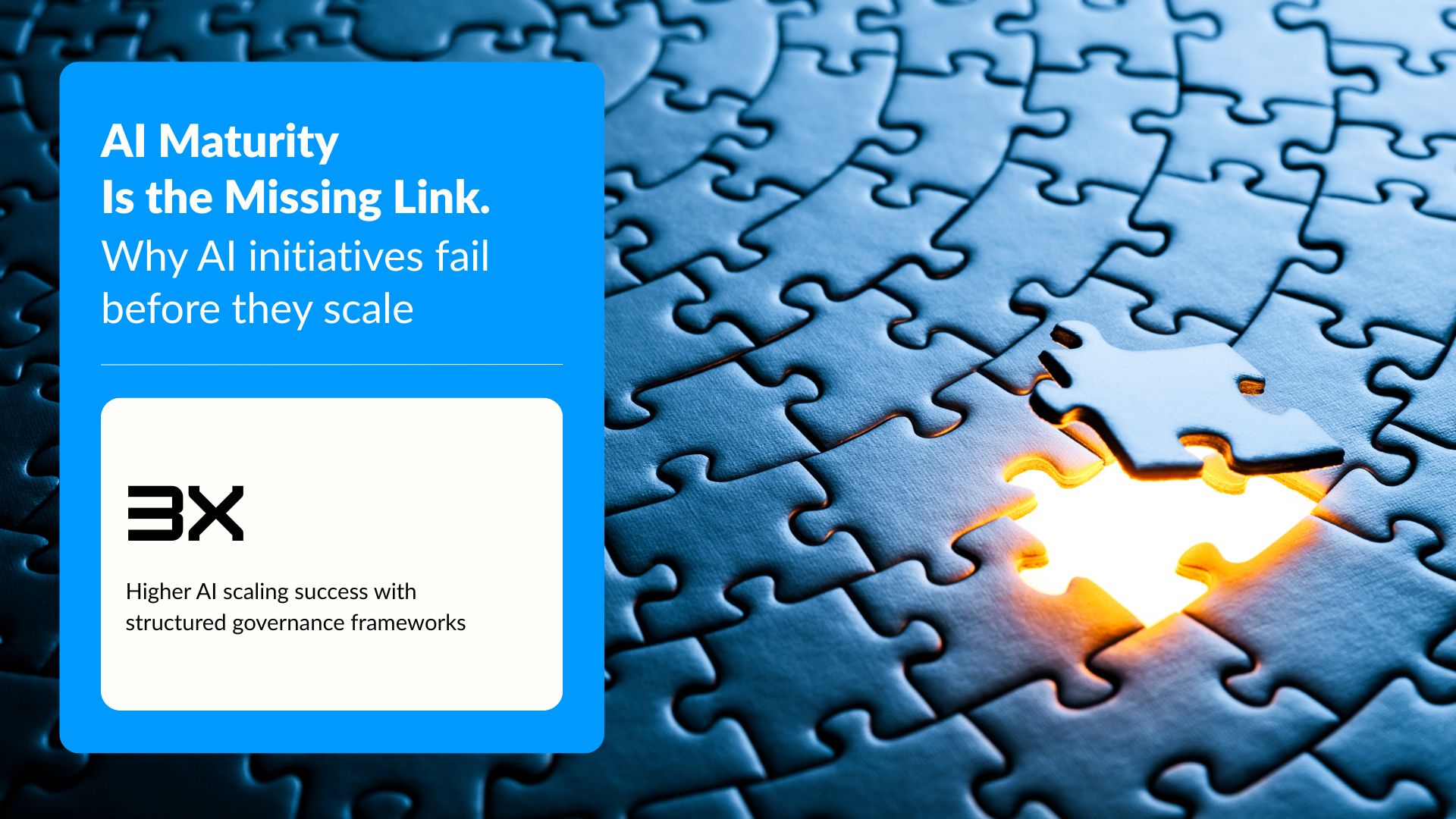
Organizations gain visibility into their current capabilities and the gaps preventing enterprise-scale adoption. According to IDC, enterprises with structured AI governance frameworks are up to 3x more likely to successfully scale AI initiatives.
This clarity enables faster decision-making, reduces investment risk, and helps prioritize initiatives aligned to business outcomes. McKinsey further reports that organizations with defined AI operating models are 1.5x more likely to achieve measurable ROI from AI investments.
More importantly, AI maturity assessment transforms AI from experimentation into a scalable driver of business value and innovation.
Turning an AI Maturity Score Into an Enterprise Roadmap
A maturity score only matters if it leads somewhere. Each identified gap should map to a specific action, owner, and expected outcome:
Maturity gap | Recommended action | Expected outcome |
Fragmented data | Strengthen data integration and governance | More reliable AI inputs |
Disconnected pilots | Establish use-case prioritization | Better investment focus |
Limited governance | Define AI governance and risk controls | Safer, more responsible adoption |
Poor scalability | Modernize AI platform capabilities | Faster pilot-to-production |
Low adoption | Build AI enablement and change programs | Higher adoption and utilization |
Unclear ROI | Define AI KPIs and value measurement | Better visibility into impact |
The roadmap should be phased so the organization fixes foundational issues while still delivering near-term business value.
How Narwal Enables Enterprise AI Maturity
Narwal’s AI Maturity Assessment is designed to bring structure, precision, and speed to enterprise AI transformation.
Built on a comprehensive framework, the assessment evaluates organizations across multiple dimensions using a set of targeted questions and evidence-based scoring. It maps organizations across clear maturity levels, from early-stage experimentation to fully optimized AI-driven enterprises.
Beyond assessment, Narwal provides actionable insights that help organizations define their roadmap, align stakeholders, and accelerate adoption. This ensures that AI initiatives are not only scalable but also aligned with measurable business value.
AI success is not accidental. It is structured, intentional, and guided by clarity.
Organizations that scale AI effectively are not necessarily investing more. They are investing smarter. They understand their maturity, identify their gaps, and execute with a clear roadmap.
As AI adoption accelerates, the difference between leaders and laggards will come down to one critical factor: clarity of execution.
The question is no longer whether to invest in AI. The question is whether you truly understand where you stand.
Take the first step toward enterprise-scale AI. Assess your AI maturity with Narwal and build a clear path from pilots to impact.
Frequently Asked Questions
A structured evaluation of an organization’s ability to adopt, deploy, govern, scale, and get measurable value from AI, examined across strategy, data, technology, governance, people, delivery, and business value.
Readiness asks whether the foundations exist to start or expand AI work. Maturity asks how effectively AI is already being used and whether it can scale responsibly.
Most models describe a progression from experimentation, through emerging and scaling adoption, to fully integrated and AI-driven operations.
Typically an initial baseline, followed by a review each time a major AI initiative launches or business priorities shift.
Typically an initial baseline, followed by a review each time a major AI initiative launches or business priorities shift.
Related Posts

AI document processing: automating binder-to-policy review
Summary AI document processing can take the manual, field-by-field work out of binder-to-policy review, where quiet mismatches in commercial insurance are easy to miss. Narwal repurposed its existing RAG Bot accelerator into a placement-ready workflow…

- Oct 01
Application Performance Monitoring: The 2026 Guide to Key Metrics, Tools, and Root Cause Analysis
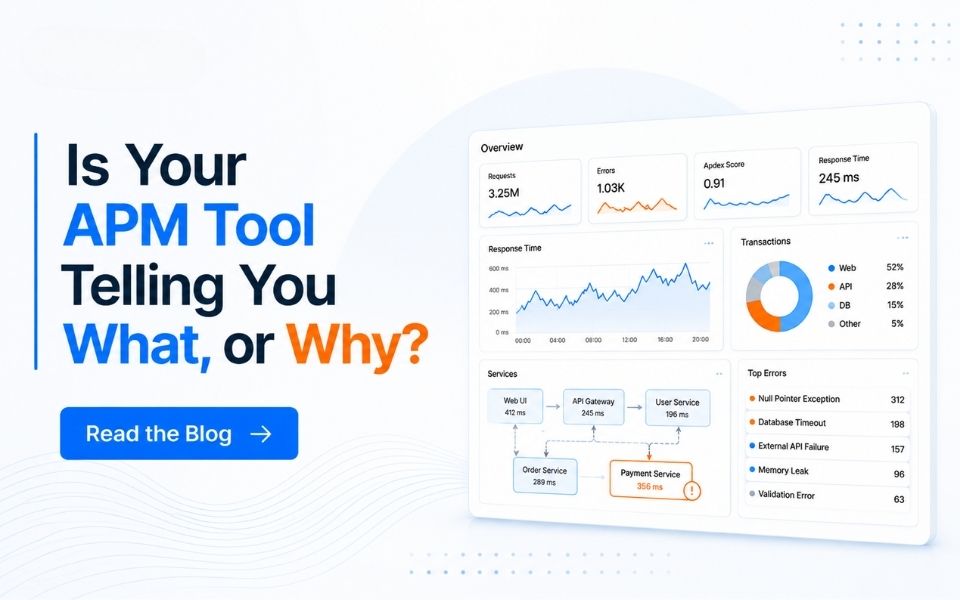
Modern applications rarely fail in one obvious place. A slow checkout page might trace back to a database query three services away. A spike in errors might be a downstream API silently timing out. Application…
- Sep 02
Categories
Latest Post


AI document processing: automating binder-to-policy review
- October 1, 2026


How AI Tests AI: Inside Autonomous Quality Engineering
- September 18, 2026
google-site-verification: google57baff8b2caac9d7.html

Headquarters
8845 Governors Hill Dr, Suite 201
Cincinnati, OH 45249
Our Branches
Cincinnati | Jacksonville | Indianapolis | London | Hyderabad | Bangalore | Pune
Narwal | © 2024 All rights reserved