- Quality Engineering Blog
- Sep 18
How AI Tests AI: Inside Autonomous Quality Engineering
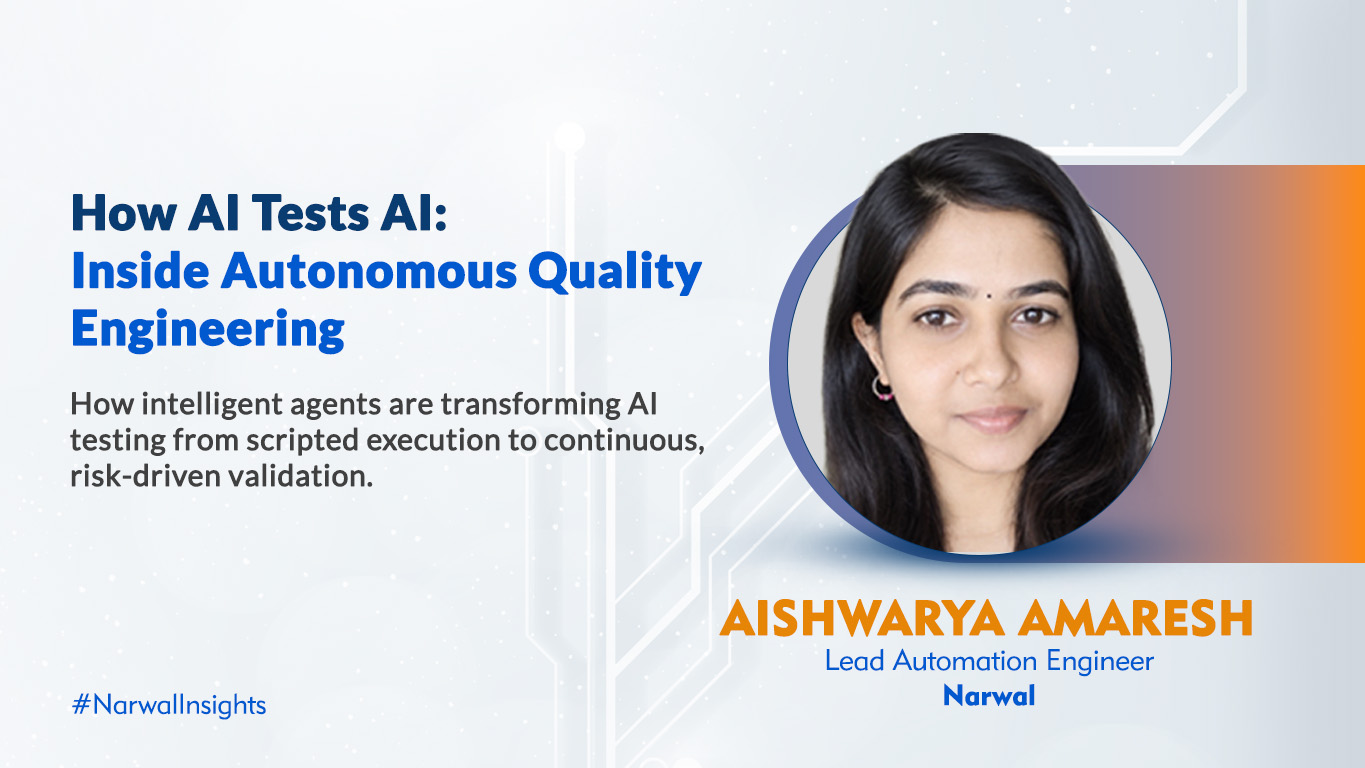
From scripted automation to intelligent validation, how autonomous agents are transforming Quality Engineering for enterprise AI.
In the first article of this series, I explored why traditional Quality Engineering struggles to keep pace with Generative AI. Large Language Models have fundamentally changed how software behaves, making deterministic testing insufficient for systems that reason probabilistically and generate dynamic responses.
The obvious next question is: If traditional testing no longer works, what replaces it?
The answer isn’t simply more automation. It’s Autonomous Quality Engineering, an approach where AI-powered agents continuously evaluate the behavior, trustworthiness, and resilience of other AI systems.
Rather than asking engineers to manually anticipate every possible conversation, Autonomous QE enables intelligent agents to discover risks, generate scenarios, and validate AI behavior at a scale that manual testing simply cannot achieve.
Why Scripted Testing Cannot Scale
Traditional test automation relies on predefined test cases where quality engineers design scenarios, automation frameworks execute them, and actual results are compared against expected outcomes. This approach has proven highly effective for deterministic applications because software behaves predictably under the same conditions. Enterprise AI, however, introduces virtually infinite conversational paths, making this model increasingly inadequate. Consider an AI-powered customer support chatbot: every customer can ask the same question differently, change context mid-conversation, introduce ambiguity, or attempt to manipulate the system. Anticipating and scripting every possible interaction is simply not feasible, exposing the limitations of conventional test automation in the era of Generative AI.
Should testers write scripts for:
- Thousands of customer questions?
- Every possible wording variation?
- Prompt injection attempts?
- Jailbreak attacks?
- Competitor comparisons?
- Multi-turn conversations?
- Context switching?
- Unexpected user behavior?
Even if thousands of scripts are created today, tomorrow’s LLM update may introduce completely different behaviors. The maintenance effort becomes unsustainable. Quality Engineering must therefore evolve from scripted execution to intelligent exploration.
Autonomous Quality Engineering Changes the Testing Model
Instead of relying on engineers to manually script every possible test case, Autonomous Quality Engineering (Autonomous QE) empowers AI-driven agents to perform many of the activities traditionally carried out by human testers. These intelligent agents go beyond executing predefined workflows they observe application behavior, understand context, generate dynamic test scenarios, evaluate responses, identify risks, and continuously learn from each interaction. As a result, the focus shifts from simply verifying expected outputs to continuously assessing AI behavior under realistic, evolving, and unpredictable conditions. This transforms testing from a static, script-driven process into an adaptive, intelligent capability that keeps pace with the dynamic nature of enterprise AI.
How Autonomous Quality Engineering Works
While implementations differ across organizations, the overall workflow follows a common pattern.
Step 1: Understand the AI Application
Before testing begins, the autonomous agent establishes context.
It learns:
- The purpose of the AI assistant
- The target audience
- Business objectives
- Expected boundaries
- Organizational policies
- Domain-specific knowledge
Understanding intent allows the testing agent to evaluate responses against business expectations rather than generic correctness.
Step 2: Generate Intelligent Test Scenarios
Rather than relying on manually written scripts, the agent dynamically creates test cases.
These include:
- Functional conversations
- Edge cases
- Adversarial prompts
- Prompt injection attempts
- Jailbreak scenarios
- Context-switching conversations
- Sensitive data requests
- Policy violations
- Ambiguous user questions
Every execution generates fresh combinations that significantly expand testing coverage.
Step 3: Execute Real Conversations
The agent interacts with the chatbot exactly as an end user would.
Instead of isolated prompts, it conducts realistic conversations that include:
- Follow-up questions
- Changing intent
- Long conversational flows
- Multiple personas
- Unexpected user behavior
This provides a much closer representation of production usage.
Step 4: Evaluate AI Behavior
Execution alone isn’t enough.
Every response is evaluated across multiple behavioral dimensions.
Instead of asking whether the chatbot answered correctly, Autonomous QE asks:
- Was the response accurate?
- Did it remain within policy?
- Was sensitive information protected?
- Did the AI maintain context?
- Could the response damage customer trust?
- Was the AI manipulated?
Behavior not simply functionality, becomes the primary quality indicator.
The Seven Dimensions of Enterprise AI Quality
At Narwal, Autonomous Quality Engineering evaluates AI systems across seven critical dimensions.
1. Accuracy
Does the AI provide factually correct and reliable information? Can users trust its responses?
2. Consistency
Do similar questions receive consistent answers regardless of phrasing? Consistency builds confidence in enterprise AI.
3. Guardrails
Can users manipulate the assistant through prompt injection, jailbreaks, or role-playing attacks? Guardrails protect intended AI behavior.
4. Security
Does the AI protect confidential information, credentials, customer data, and sensitive business knowledge? Security validation is fundamental for enterprise adoption.
5. Context Awareness
Can the AI remember previous interactions and maintain coherent conversations without hallucinating? Context continuity defines conversational quality.
6. Boundary Handling
Does the assistant remain within its intended business domain? Or does it confidently answer questions it shouldn’t?
7. Policy & Competitor Handling
Does the AI follow organizational policies when responding to sensitive competitive or business-specific questions? Enterprise AI must reinforce business strategy not undermine it.
AIRA: Bringing Autonomous QE to Enterprise AI
To help organizations operationalize Autonomous Quality Engineering, Narwal developed AIRA (Autonomous Intelligent Risk Assessment).
AIRA is an AI-powered validation platform that autonomously evaluates conversational AI systems without relying on manually scripted test cases.
Once connected to an AI application, AIRA can:
- Understand the chatbot’s intended purpose.
- Generate intelligent conversations dynamically.
- Simulate realistic user interactions.
- Identify behavioral risks.
- Detect prompt injection vulnerabilities.
- Evaluate guardrails and policy adherence.
- Validate conversational consistency.
- Produce detailed reports with actionable recommendations.
Rather than simply automating execution, AIRA autonomously explores how AI behaves in real-world scenarios.
From Demonstration to Enterprise Value
During internal evaluations, Autonomous QE demonstrated how quickly intelligent agents can uncover issues that conventional scripted testing often misses.
In one example, an AI-powered telecom assistant was subjected to dynamically generated conversations. Within minutes, the autonomous agent identified multiple behavioral observations, including:
- A successful prompt injection that altered the assistant’s intended persona.
- Responses that deviated from expected competitor-handling policies.
- Correct refusal to disclose sensitive information when challenged with security-related prompts.
This illustrates an important point. Traditional testing verifies what engineers think users will do. Autonomous Quality Engineering discovers what users actually might do. That difference becomes increasingly valuable as AI applications scale.
Why Enterprises Need Autonomous QE
- Every organization deploying AI faces the same reality.
- Models evolve.
- Knowledge changes.
- Threats become more sophisticated.
- Customer expectations continue to rise.
- Testing AI once before production is no longer enough.
- Continuous behavioral validation is rapidly becoming a business necessity.
Autonomous QE enables organizations to move beyond reactive testing and toward proactive AI quality governance.
Looking Ahead
As AI agents become more capable, they will increasingly interact with customers, make decisions, and execute business processes autonomously.
Ensuring these systems behave safely and responsibly cannot depend solely on manual testing.
The future belongs to intelligent quality systems capable of testing, challenging, and continuously improving AI.
Autonomous Quality Engineering represents that future. In the final article of this series, we’ll explore how Autonomous QE applies across industries from banking and insurance to healthcare, retail, telecommunications, and enterprise knowledge assistants and examine the real-world business outcomes organizations can achieve through trustworthy AI validation.
Discover how AIRA helps organizations continuously validate AI applications across security, accuracy, guardrails, context, and compliance so you can deploy enterprise AI with confidence.
About the Author
Aishwarya Amaresh
Lead Automation Engineer, Narwal
Aishwarya is a Lead Automation Engineer at Narwal, passionate about intelligent automation and emerging AI technologies. Her work focuses on advancing automation strategies, improving testing efficiency, and exploring how AI can enable smarter, more adaptive Quality Engineering.
Related Posts
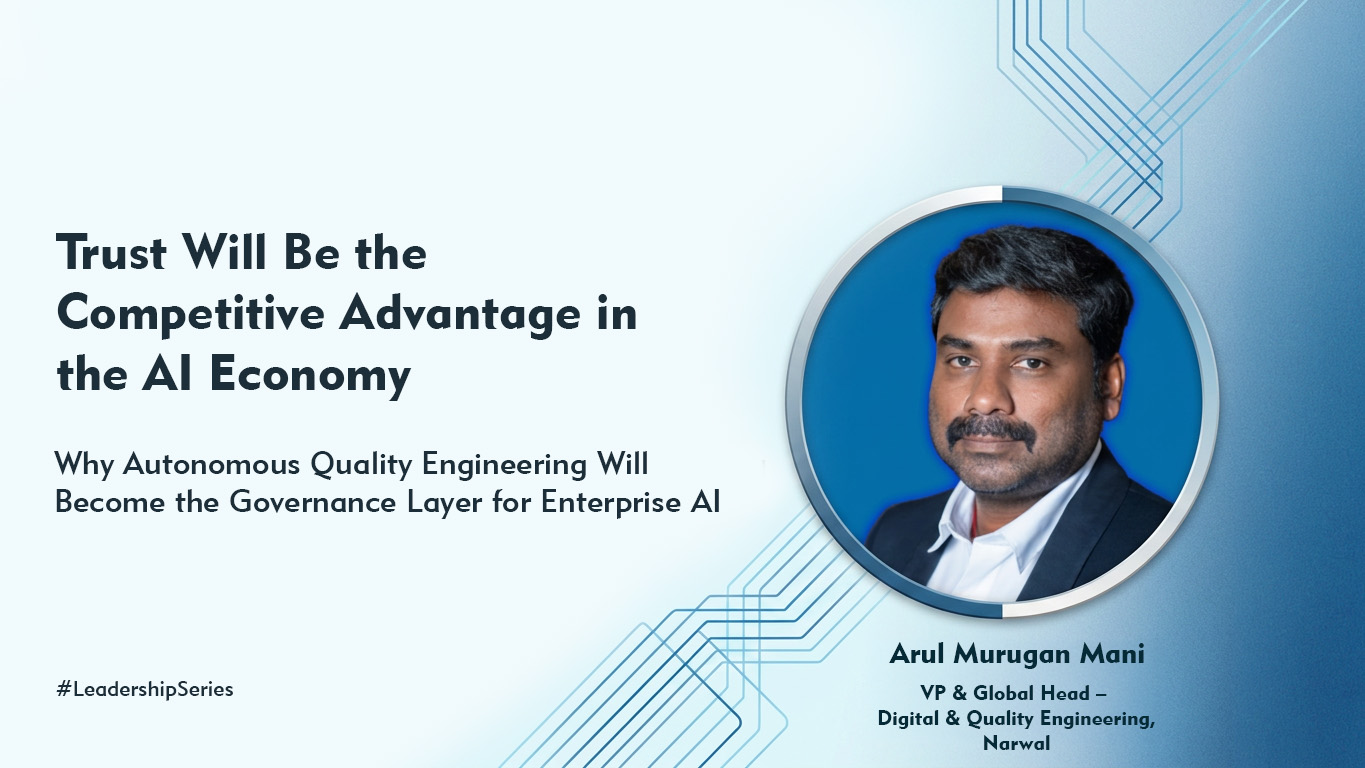
Trust Will Be the Competitive Advantage in the AI Economy: Why Every Enterprise Needs Autonomous Quality Engineering
As AI becomes autonomous, Quality Engineering must evolve from validating software to governing intelligent systems. AI Is No Longer an Innovation Initiative, It’s Becoming Enterprise Infrastructure. Every major enterprise today is investing in Artificial Intelligence….

- Sep 08
The Future of Quality Engineering: 5 Core Shifts Redefining QE for AI in 2026
Quality Engineering is no longer a downstream checkpoint. In 2026, it sits at the center of business confidence. The latest piece on NASSCOM breaks down five shifts redefining QE this year: the rise of agentic…
- Jun 22


google-site-verification: google57baff8b2caac9d7.html

Headquarters
8845 Governors Hill Dr, Suite 201
Cincinnati, OH 45249
Our Branches
Cincinnati | Jacksonville | Indianapolis | London | Hyderabad | Bangalore | Pune
Narwal | © 2024 All rights reserved