
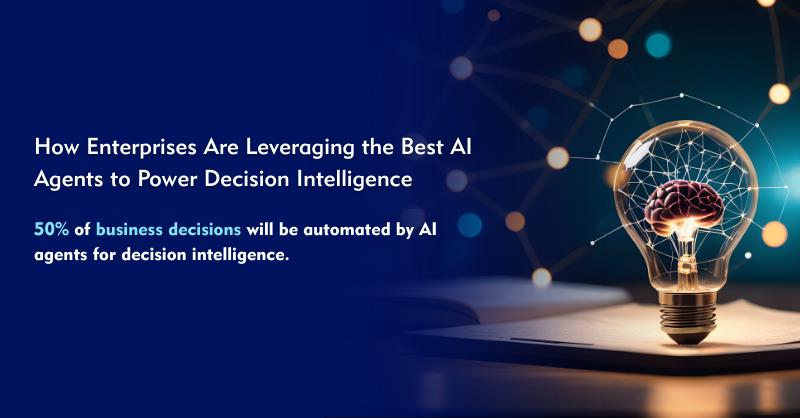
Artificial intelligence is entering a new phase of evolution. While generative AI initially transformed how organizations create content, write code, and analyze information, the next wave of innovation is centered around intelligent autonomous systems known as AI agents. These systems go beyond answering questions or generating responses. They are capable of understanding complex environments, reasoning about goals, and executing tasks across enterprise systems.
In modern enterprises where digital ecosystems include multiple cloud platforms, applications, and data environments, the ability to automate decisions and actions has become critical. AI agents are emerging as the operational layer that connects data, analytics, and automation into a cohesive intelligence framework. As organizations increasingly invest in enterprise AI adoption, identifying and implementing the best AI agents has become a strategic priority for technology leaders.
Understanding AI Agents in the Enterprise Context
AI agents are autonomous software entities designed to observe their environment, process information, make decisions, and perform actions that achieve predefined goals. Unlike traditional AI systems that primarily produce insights or predictions, AI agents actively participate in business operations by orchestrating workflows, interacting with systems, and continuously adapting to new inputs.
These systems typically combine multiple technologies including large language models, machine learning algorithms, reasoning engines, and enterprise integration frameworks. By integrating these components, AI agents can interpret user intent, retrieve relevant data, generate recommendations, and execute tasks across digital environments.
Industry research increasingly highlights the growing importance of agent-based architectures. According to McKinsey, organizations that successfully operationalize AI across enterprise workflows can achieve significant productivity improvements and decision acceleration. At the same time, Gartner predicts that agentic AI systems will become a fundamental component of enterprise software architectures as organizations seek to scale automation and intelligence simultaneously.
Why Enterprises Are Investing in AI Agents
The growing interest in AI agents is closely tied to the increasing complexity of enterprise technology ecosystems. Organizations operate across distributed systems that include ERP platforms, customer relationship management tools, analytics platforms, cloud environments, and operational databases. Coordinating activities across these environments often requires manual intervention or fragmented automation processes.
AI agents provide a solution by enabling intelligent orchestration across systems. Instead of relying on static automation scripts, AI agents analyze contextual information and dynamically determine how workflows should proceed. This capability allows enterprises to automate complex tasks such as customer interactions, operational decision-making, financial analytics, and data management.
As organizations scale digital transformation initiatives, AI agents are increasingly seen as a mechanism for bridging the gap between data insights and operational execution. By embedding intelligence directly into workflows, enterprises can reduce operational complexity, accelerate decision cycles, and improve productivity across departments.
Key Characteristics of the Best AI Agents
The most effective AI agents are defined by their ability to operate reliably within enterprise environments while delivering measurable business outcomes. The best AI agents demonstrate contextual awareness, allowing them to interpret signals from both structured and unstructured data sources. They also possess reasoning capabilities that enable them to evaluate possible outcomes before executing actions.
Another defining characteristic of enterprise AI agents is their ability to integrate seamlessly with existing systems. This integration ensures that AI agents can interact with enterprise applications such as data warehouses, cloud platforms, and SaaS tools without disrupting existing workflows. Finally, advanced AI agents continuously learn from operational feedback, allowing them to improve performance over time.
Together, these characteristics transform AI agents from simple automation tools into digital collaborators capable of supporting complex enterprise operations.
Enterprise Applications of AI Agents
AI agents are already transforming operations across multiple industries and business functions. In customer experience environments, conversational AI agents enable organizations to deliver intelligent support and personalized interactions at scale. These agents can understand natural language queries, retrieve relevant information from enterprise systems, and automate resolution workflows.
In data-driven organizations, AI agents play a critical role in analyzing information and supporting decision-making processes. Data intelligence agents can monitor pipelines, detect anomalies, generate insights, and trigger automated responses when specific conditions occur.
Software engineering and DevOps teams are also leveraging AI agents to accelerate development workflows. Engineering agents can generate code, automate testing processes, and identify potential defects before software is deployed into production environments.
These applications illustrate how AI agents extend automation beyond repetitive tasks into areas requiring contextual understanding and adaptive decision-making.
Narwal AI Accelerators Enabling Enterprise AI Agents
At Narwal, AI agents are implemented as part of a broader enterprise AI ecosystem supported by specialized accelerators and frameworks. These accelerators are designed to help organizations move from experimental AI initiatives to scalable enterprise deployments.
Narwal’s Agentic AI Accelerator provides a structured framework for building AI agents capable of reasoning, planning, and executing enterprise workflows. By combining advanced AI models with enterprise data systems, this accelerator enables organizations to create intelligent automation solutions that improve operational efficiency and support strategic decision-making.
Narwal also enables the deployment of autonomous multi-agent systems where multiple AI agents collaborate to perform complex tasks. These multi-agent environments allow enterprises to distribute responsibilities across specialized agents that coordinate actions and share contextual information.
To ensure responsible AI adoption, Narwal integrates a Human-in-the-Loop AI framework that embeds human oversight into AI workflows. This framework ensures that enterprise AI systems remain transparent, explainable, and aligned with regulatory requirements and governance standards.
Narwal’s multi-modal AI capabilities further enhance AI agent performance by allowing agents to interpret and analyze multiple forms of data including text, images, structured datasets, and operational signals. By combining these capabilities, enterprises can unlock deeper insights and enable more sophisticated decision intelligence.
Another critical component of Narwal’s AI ecosystem is the self-learning knowledge graph automation framework. Knowledge graphs provide contextual understanding of relationships between enterprise data elements, enabling AI agents to make more accurate decisions and adapt to evolving business environments.
Enterprise Benefits of AI Agents
Organizations deploying enterprise-grade AI agents experience significant improvements across several dimensions of performance and innovation. AI agents accelerate AI adoption by simplifying the implementation of intelligent automation solutions across departments. They enable organizations to automate complex processes while maintaining governance and control over decision-making workflows.
AI agents also enhance data-driven intelligence by transforming enterprise data into actionable insights that support real-time operational decisions. By integrating analytics directly into workflows, organizations can reduce delays between analysis and execution.
In addition, AI agents support the creation of future-ready technology architectures. These architectures integrate AI capabilities into enterprise systems while remaining flexible enough to accommodate emerging technologies such as generative AI, multi-agent collaboration, and advanced analytics platforms.
Finally, enterprise AI agents enable seamless integration across systems and applications. This integration ensures that organizations can leverage existing technology investments while expanding their automation capabilities through intelligent orchestration.
The Future of AI Agents in Enterprise Transformation
The rapid advancement of AI technologies suggests that agentic systems will play a central role in the future of enterprise computing. Instead of deploying isolated AI models for specific tasks, organizations are increasingly adopting architectures where multiple AI agents collaborate to execute workflows and support decision-making processes.
According to IDC, organizations that successfully operationalize AI-driven automation achieve higher levels of productivity and faster innovation cycles compared to those relying solely on traditional automation technologies.
As enterprise ecosystems become more complex and data-driven, AI agents will serve as the connective layer that integrates data, analytics, automation, and decision intelligence. Organizations that adopt this paradigm early will gain significant advantages in agility, efficiency, and innovation.
Building Enterprise AI Agents with Narwal
At Narwal, we help enterprises design and deploy scalable AI ecosystems powered by intelligent accelerators and enterprise-grade governance frameworks. Our AI solutions enable organizations to implement AI agents that automate complex workflows, enhance decision intelligence, and unlock value from enterprise data.
By combining advanced AI engineering practices with strong governance models, Narwal ensures that AI agents operate securely, transparently, and at enterprise scale. Organizations that embrace intelligent AI agents today will be better positioned to lead in an increasingly digital and data-driven economy.
References
McKinsey & Company – The State of AI and Intelligent Automation in Enterprises
Gartner – Emerging Technologies and Autonomous AI Systems
IDC – Enterprise AI Adoption and Intelligent Automation Trends
Forrester – Intelligent Automation and the Future of Enterprise Workflows
Related Posts
Top 5 AI Trends for 2026: Where Intelligence Will Reshape the Enterprise Core
How AI Is Rewiring Software, Data, Security, and Business Decision-Making Artificial Intelligence is no longer operating at the edges of enterprise systems. It is steadily moving closer to the core of how software is built, data is…

- Feb 25

Unlocking Enterprise Intelligence with Multi-Modal AI: From Data Fusion to Autonomous Decision-Making
Enterprises are entering a new phase of artificial intelligence adoption one where intelligence is no longer confined to text or numbers alone. Today’s business environments generate signals across documents, images, videos, audio, sensor streams, logs, and…
- Feb 05


google-site-verification: google57baff8b2caac9d7.html

Headquarters
8845 Governors Hill Dr, Suite 201
Cincinnati, OH 45249
Our Branches
Cincinnati | Jacksonville | Indianapolis | London | Hyderabad | Bangalore | Pune
Narwal | © 2024 All rights reserved