- Quality Engineering Blog
- Sep 08
Trust Will Be the Competitive Advantage in the AI Economy: Why Every Enterprise Needs Autonomous Quality Engineering
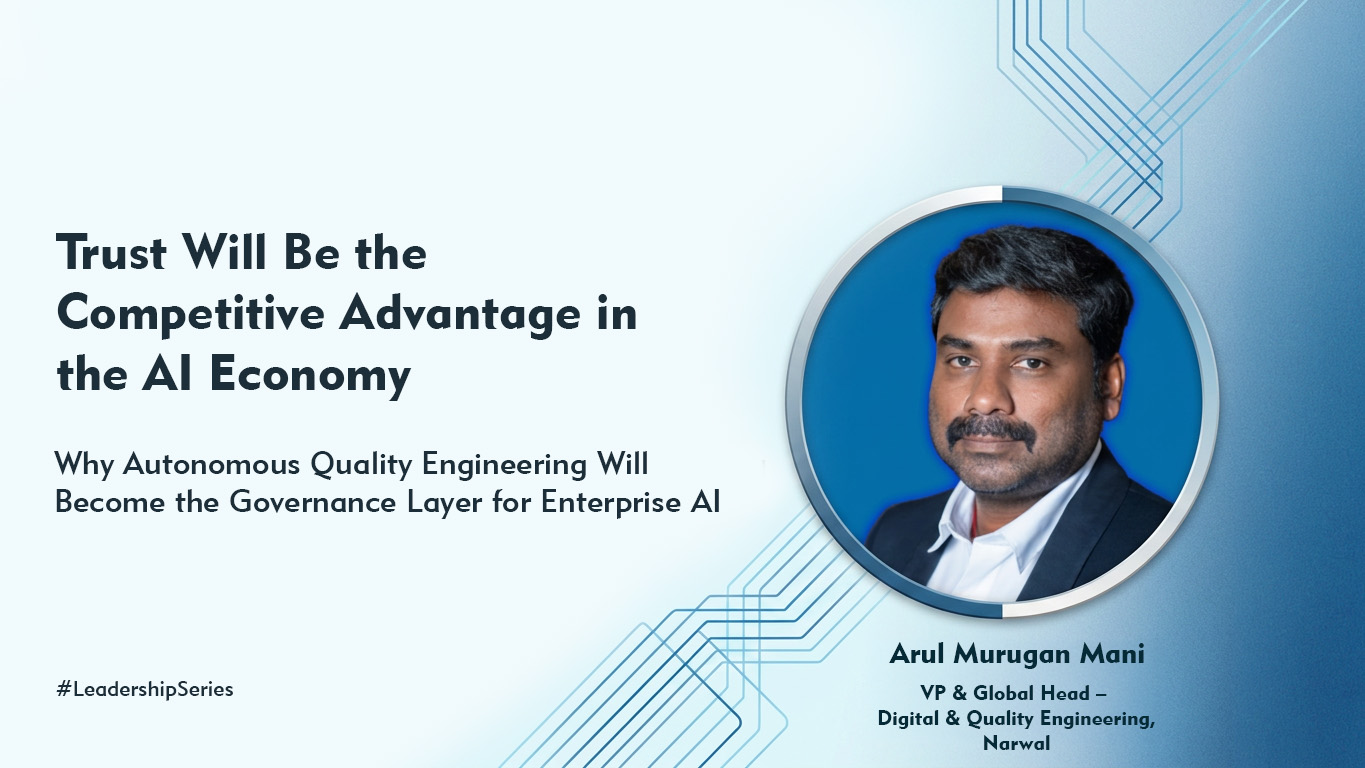
As AI becomes autonomous, Quality Engineering must evolve from validating software to governing intelligent systems. AI Is No Longer an Innovation Initiative, It’s Becoming Enterprise Infrastructure. Every major enterprise today is investing in Artificial Intelligence.
Some are deploying customer service assistants. Others are building developer copilots, enterprise knowledge agents, claims automation, healthcare assistants, procurement advisors, or intelligent business workflows.
The conversation has shifted from “Should we adopt AI?” to “How quickly can we scale it?”
Yet, as organizations accelerate AI adoption, many are overlooking the question that will ultimately determine long-term success:
Can your enterprise trust its AI?
Not whether it can answer questions. Not whether it can summarize documents. Not whether it can automate workflows.
But whether it will consistently behave in ways that are accurate, secure, compliant, and aligned with your business objectives. In my view, this is rapidly becoming one of the most important strategic challenges facing enterprise technology leaders.
AI Doesn’t Fail Like Traditional Software
Historically, software failures were relatively straightforward.
- An application crashed.
- A transaction failed.
- An API timed out.
These were engineering problems that could be reproduced, diagnosed, and resolved. AI introduces a fundamentally different category of risk.
The system may continue functioning perfectly from a technical perspective while simultaneously producing inaccurate recommendations, exposing confidential information, violating business policies, or responding inconsistently to similar customer interactions.
- Technically, the application works.
- From a business perspective, it has failed.
- This distinction changes everything.
- Enterprise AI cannot be evaluated solely through functional correctness.
It must be evaluated through behavioral trust.
The Organizations That Win with AI Will Govern It Better
Every technological revolution has introduced a new competitive differentiator.
- Cloud rewarded scalability.
- Data rewarded insight.
- Automation rewarded efficiency.
- The AI era will reward trust.
Organizations that can confidently deploy AI into customer-facing and business-critical processes will innovate faster than those forced to slow adoption because of quality, compliance, or governance concerns.
- Trust is no longer a soft metric.
- It is becoming an operational capability.
- This means AI quality can no longer be viewed as an engineering responsibility alone.
It is becoming a board-level discussion involving technology leaders, risk officers, compliance teams, legal stakeholders, and business executives.
Why Autonomous Quality Engineering Is Becoming the AI Governance Layer
As AI systems become increasingly autonomous, testing cannot remain a manual activity performed before production.
- Enterprise AI evolves continuously.
- Models are updated.
- Knowledge bases change.
- Policies evolve.
- Threats become more sophisticated.
- Static testing simply cannot keep pace.
This is where I believe Autonomous Quality Engineering represents the next major evolution in enterprise technology. Rather than validating software at fixed points in time, Autonomous QE continuously evaluates how AI systems behave under changing conditions.
It moves quality engineering from defect detection to behavioral governance.
Instead of asking: “Did the application pass testing?”
Organizations begin asking:
- Can we trust this AI to represent our brand?
- Will it remain compliant tomorrow?
- Can it withstand emerging attack vectors?
- Is it making decisions we can explain?
- Is customer trust improving or eroding?
These are strategic business questions. Autonomous QE provides the operational capability to answer them continuously.
AI Governance Must Become Continuous
AI governance cannot rely solely on policies, reviews, and documentation. AI systems evolve continuously, and governance must keep pace. Organizations need ongoing validation to identify emerging risks and ensure AI remains secure, compliant, and aligned with business objectives. In the AI era, governance is not something you document, it is something you continuously demonstrate.
The Next Generation of Quality Engineering Will Be Autonomous
Quality Engineering has evolved from manual testing to automation and AI-assisted practices. The next evolution is Autonomous Quality Engineering. Autonomous agents can explore unpredictable behaviors, validate guardrails, detect risks, and assess compliance with minimal human intervention. This elevates the role of quality engineers from maintaining scripts to shaping quality strategy and governance. Quality Engineering is no longer just a delivery function, it is becoming a strategic enabler of trusted AI.
Narwal’s Vision: Engineering Trust into Enterprise AI
At Narwal, we believe the next frontier of Quality Engineering is not simply about testing smarter. It is about engineering trust into intelligent systems.
As enterprises move from AI experimentation to production-scale adoption, the challenge is no longer limited to building capable models. The greater challenge is ensuring those models continue to behave reliably as interactions, data, business contexts, and risks evolve.
This requires a fundamental shift in how enterprises think about quality.
Traditional Quality Engineering was designed to validate whether software works. In the AI era, Quality Engineering must also validate how intelligent systems behave, whether they remain accurate, secure, resilient, compliant, and aligned with the intent of the business. That is the vision behind Narwal’s Autonomous Quality Engineering approach.
We are bringing together deep Quality Engineering expertise, AI-driven intelligence, and autonomous validation to help organizations continuously evaluate enterprise AI systems, not as a one-time testing exercise, but as an ongoing discipline that supports responsible scale.
Our vision is to enable enterprises to move from reactive defect detection to proactive behavioral assurance.
From testing predefined scenarios to exploring the unknown.
From periodic validation to continuous intelligence.
And ultimately, from simply deploying AI to deploying AI with confidence.
This vision is brought to life through AIRA (Autonomous Intelligent Risk Assessment), Narwal’s Autonomous QE platform designed to intelligently assess conversational AI, enterprise copilots, and emerging agentic applications. AIRA enables organizations to evaluate critical dimensions of AI behavior, including accuracy, security, guardrails, context awareness, policy adherence, and behavioral consistency, while uncovering risks that conventional scripted testing may fail to anticipate.
But the larger ambition goes beyond a platform.
We see Autonomous Quality Engineering becoming a foundational layer in the enterprise AI ecosystem, one that enables organizations to innovate faster without compromising trust.
As AI systems become more autonomous, the ability to continuously challenge, validate, and govern their behavior will become just as important as the ability to build them.
At Narwal, our focus is on helping enterprises prepare for that future.
Because the true measure of successful AI adoption will not be how intelligently a system can respond, but how confidently an enterprise can rely on it.
Looking Beyond Today
Artificial Intelligence is steadily becoming embedded in enterprise decisions, customer interactions, and business operations. As organizations embrace copilots, autonomous agents, and increasingly sophisticated AI-driven workflows, trust will become a defining differentiator.
The organizations that lead in the AI economy will not necessarily be those with access to the most powerful models. They will be the ones that create the greatest confidence in how those models behave.
Quality Engineering has always enabled confidence in software. In the AI era, its role becomes even more consequential: enabling confidence in intelligence itself.
That is why Autonomous Quality Engineering will emerge as more than a testing discipline. It will become a strategic enterprise capability, helping organizations govern AI behavior, manage risk, and scale innovation with confidence.
And that may ultimately be the defining challenge of the AI era: not simply building intelligence, but building intelligence that enterprises can trust.
About the Author
Arul Murugan Mani
VP & Global Head – Digital & Quality Engineering, Narwal
Arul Murugan Mani leads Narwal’s Digital and Quality Engineering practice, helping enterprises transform quality engineering through AI-driven innovation, autonomous testing, and intelligent quality platforms. He advises global organizations on building trustworthy, scalable AI ecosystems and believes Autonomous Quality Engineering will become the foundation of enterprise AI governance.
Related Posts
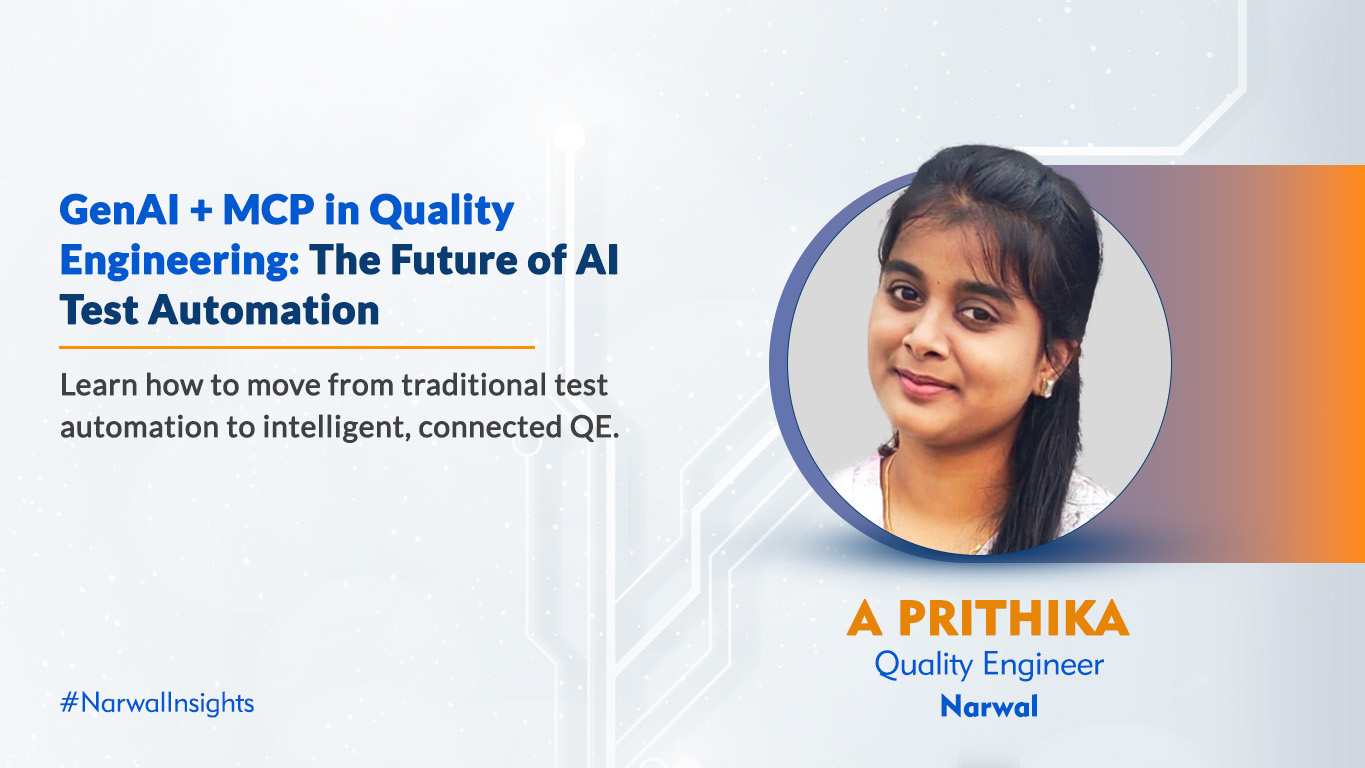
GenAI + MCP in Quality Engineering: The Future of AI Test Automation
Introduction AI test automation is helping teams accelerate software testing, but traditional automation still has clear limitations. Scripts take time to write and can break when applications change. Maintenance consumes the hours automation was meant…

- Oct 08
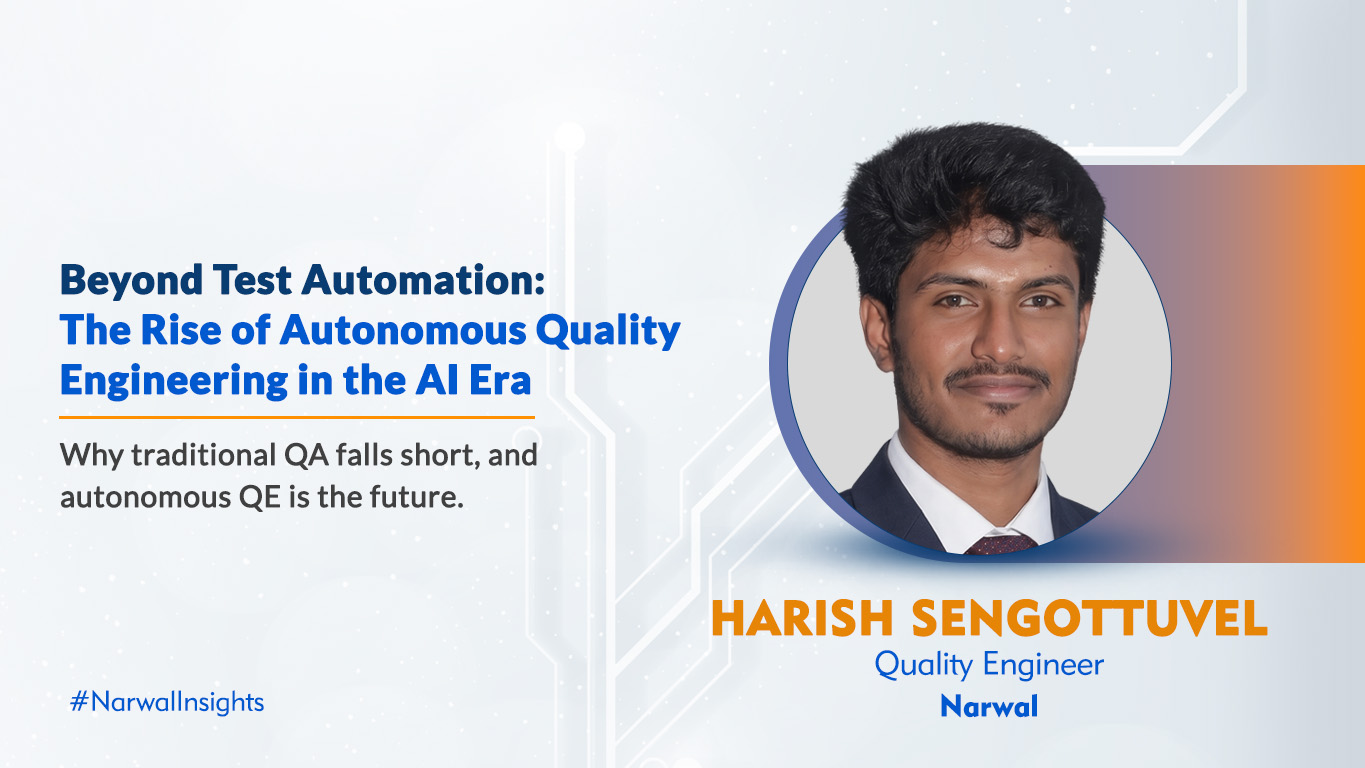
Beyond Test Automation: The Rise of Autonomous Quality Engineering in the AI Era
Why traditional QA is reaching its limits, and how Autonomous Quality Engineering is redefining software quality for the age of Generative AI. Artificial Intelligence has fundamentally changed how software is built, delivered, and experienced. Across…
- Sep 24
Categories
Latest Post


AI document processing: automating binder-to-policy review
- October 1, 2026


How AI Tests AI: Inside Autonomous Quality Engineering
- September 18, 2026
google-site-verification: google57baff8b2caac9d7.html

Headquarters
8845 Governors Hill Dr, Suite 201
Cincinnati, OH 45249
Our Branches
Cincinnati | Jacksonville | Indianapolis | London | Hyderabad | Bangalore | Pune
Narwal | © 2024 All rights reserved