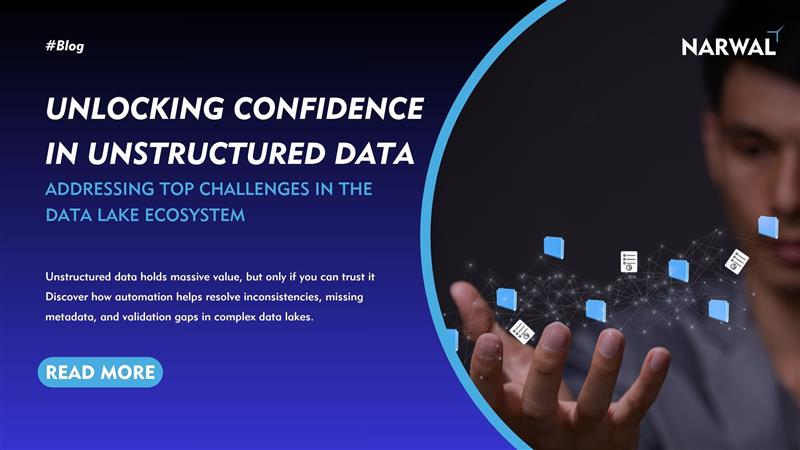
As organizations expand their digital transformation efforts, they increasingly rely on data lakes for unstructured data storage and analysis. Unstructured data—text files, XMLs, raw logs—doesn’t fit into traditional data structures, making it complex to manage and validate within a data lake. In response to the growing demand for reliable data insights, ensuring the accuracy of unstructured data has become critical to maintaining a competitive edge. Without reliable data, your organization can be susceptible to compliance fines, migration or transformation failures, and biased AI/ML projects.
What is unstructured data validation?
Unstructured data validation is the process of checking that files such as text documents, XML, raw logs and mainframe extracts are complete, correctly formatted and consistent with their source before and after they enter a data lake. Without a fixed schema to test against, validation relies on metadata, format rules, content checks and source-to-target comparisons instead.
Understanding the Key Challenges of Unstructured Data in Data Lakes
Unstructured data lacks a predefined format, which introduces unique challenges in maintaining data quality and consistency. Here are some of the most common issues:
- Data Source Inconsistencies: With multiple data sources feeding into a data lake, keeping the structure uniform is a constant battle. When each source has a different data structure or format, creating a cohesive view of the data landscape becomes nearly impossible.
- Lack of Metadata: Unstructured data often comes without the metadata needed to organize, classify, and retrieve information efficiently. Without these essential descriptors, data lakes can quickly turn into “data swamps,” making it challenging to derive actionable insights.
- Resource Constraints in Data Quality Management: According to the O’Reilly State of Data Quality Report, many organizations struggle to maintain data quality due to limited resources. Testing unstructured data manually is time-consuming and prone to error, underscoring the need for automation to ensure quality at scale.
- Schema-on-Read Flexibility: A data lake accepts files without checking them on arrival. That flexibility is why lakes scale so well, and also why errors often surface only after a report or model has already used the data. Analyst research describes this as the central trade-off of the data lake model.
- Corrupted or Incomplete Files: Truncated files, damaged headers and empty records can slip in unnoticed because nothing inspects them at the door.
- Duplicates and Format Drift: The same record can arrive from several sources, or change shape between loads, which quietly breaks downstream pipelines.
Unstructured data validation methods
No single check covers every file type. Most unstructured data validation programs combine the methods below.
Method | What it checks | Example |
Metadata checks | Files carry the descriptors needed to classify and retrieve them | Required fields present, confidentiality tags preserved |
Format and structure checks | Files follow the expected layout | XML elements in place, fields in the right positions of a mainframe record |
Content checks | Values fall inside expected ranges and patterns | Valid dates, amounts and codes |
Reconciliation | Source and target agree after loading | Record counts and field-level comparison |
Continuous monitoring | Pipelines stay healthy over time | Row counts, data distribution, ETL verification |
The Value of Automated Data Quality Solutions
Automating data quality processes offers a strategic solution to overcome these challenges. Tricentis Data Integrity (DI) provides a powerful approach to data validation across complex data pipelines. Here’s how Data Integrity addresses the common challenges of unstructured data:
- Pre-Ingestion Checks and Continuous Monitoring: Data Integrity performs comprehensive checks—such as metadata completeness and data integrity—before ingestion to ensure data is ready for use. It also offers continuous monitoring through crucial validations like row counts, data distribution, and ETL (Extract, Transform, Load) verification as data moves through the pipeline.
- Field and Reconciliation Testing: Data Integrity checks data fields for consistency in values, range, and transformation while running source-to-target comparisons to ensure accuracy across the board.
- Time and Cost Efficiency: By automating these tasks, Data Integrity enables organizations to reach up to 90% automation, significantly reducing the QA cycle and associated costs.
Manual vs automated unstructured data validation
Aspect | Manual validation | Automated validation |
Coverage | Samples of files | Every file and every load |
Speed | Slow, and grows with data volume | Runs on a schedule and scales with the pipeline |
Consistency | Varies by tester | Same rules on every run |
Cost | Rises with each new source | Falls after setup as checks are reused |
Audit trail | Scattered notes | Logged results for every run |
What to look for in a data quality automation tool
When comparing options for unstructured data validation, check for the following.
- Format coverage. It handles the file types you actually have, such as XML, mainframe files and logs.
- Target connectivity. It connects to your platforms, for example Azure Databricks, Impala, SQL Server or Oracle.
- Checks before and after ingestion. Pre-ingestion checks, reconciliation and continuous monitoring sit in one place.
- Scheduling and reuse. Tests run on a schedule and test logic carries over to similar files.
- Reporting. Results are readable by auditors and data owners, not just testers.
Case Study: Automation in Action
Narwal has successfully leveraged Data Integrity to automate validation for unstructured data from both mainframe files and XML sources. Here’s how automation helped streamline two complex scenarios:
- Validating Mainframe Data in Azure Databricks: Mainframe files, often unstructured and difficult to process, present a challenge when validating against modern cloud databases like Azure Databricks. With Data Integrity, Narwal was able to automate this process from start to finish, eliminating the need for manual intervention and transforming validation into a quick, reliable daily task.
- XML File Validation in Impala: With over 400 variations of XML files, manual validation would have been an unfeasible, resource-intensive effort. By automating the process with Data Integrity, Narwal could load XML data into a caching database, format it correctly, and conduct automated validation—turning an otherwise monumental task into a scheduled, hands-off process.
Best practices for unstructured data validation in a data lake
- Validate at the door. Check files before ingestion so bad data never reaches the lake.
- Define quality rules with owners. Agree on measurable standards with the people who own each source.
- Keep metadata complete. Research on data lake pipelines points to metadata as central to quality, so treat missing descriptors as a defect.
- Automate reconciliation. Compare source and target on every load, not only at go-live.
- Monitor continuously. Watch row counts and distributions so drift is caught early.
Unstructured data quality is not a one-time cleanup. It needs ongoing ownership, even when the checks themselves are automated.
Achieving Business Confidence with Data Quality Automation
For organizations looking to enhance their decision-making capabilities, unstructured data quality is paramount. Tricentis Data Integrity has been instrumental in achieving higher accuracy, reduced cycles, and lower costs, as demonstrated by Narwal’s success stories. These outcomes highlight the value of automated solutions that address data complexity while ensuring integrity every step of the way. Tricentis Data Integrity has become more than a testing tool, it is a risk mitigation tool.
By adopting an automated approach to unstructured data validation, organizations can move confidently toward digital transformation. Reliable data quality not only accelerates business processes but also provides the foundation for strategic, data-driven decisions, making it essential for staying competitive in today’s data-driven landscape.
Want to see how automation solves the toughest data challenges? Join us at Tricentis Transform 2025 in Nashville. We’ll be showcasing real-world strategies to eliminate costly data errors across data lakes, migrations, and ETL pipelines.
References:
- O’Reilly. The State of Data Quality Report. Available at: https://www.oreilly.com/data/
- (Cited for resource constraints and data quality management statistics)
- MIT Sloan Management Review. “The Cost of Bad Data.” Available at: https://sloanreview.mit.edu/
(Referenced in the context of the financial impact of poor data quality on organizations)
- Tricentis. “Tricentis Tosca Data Integrity: Automated Testing for Data Quality.” Available at: https://www.tricentis.com/
- Narwal Case Studies. Automated Unstructured Data Validation for Enterprise Data Lakes. Narwal Inc. Available at: https://www.narwalinc.com/
Aragon Research. Data Quality is Not Auto-magic in a Data Lake or Lakehouse: https://aragonresearch.com/data-quality-is-not-auto-magic/
Using Apache Spark for Ensuring Data Quality in Modern Data Lake Pipeline Architectures (CEUR Workshop Proceedings): https://ceur-ws.org/Vol-3588/p15.pdf
Frequently Asked Questions
It confirms that unstructured files, such as XML, logs and mainframe extracts, are complete, consistently formatted and accurate compared with their source. Because there is no fixed schema, it relies on metadata, format and content checks and reconciliation.
Lakes accept data in any format without checking it. When metadata is missing, sources are inconsistent and nothing validates files on arrival, the data becomes hard to find, trust and use.
Validation checks whether data meets defined rules and flags problems. Cleansing fixes those problems. Validation usually comes first, so teams know what needs cleaning.
No. It sharply reduces risk and catches most issues early, but accuracy depends on the quality of the rules and how often they are updated. Continuous monitoring helps close the gap.
Platforms such as Tricentis Data Integrity run pre-ingestion checks, reconciliation and monitoring on a schedule. Narwal has used this approach to automate validation for mainframe files and XML sources.
Related Posts

5 Signs Your Data Engineering for AI Is Solving the Wrong Problems
Your data engineering team is doing the work. Pipelines are up and running. Tickets are getting closed. Yet data engineering for AI is a different game, and the gap is starting to show. AI initiatives…

- Jun 26
Data Governance for AI: Building Trusted Enterprise Data for an AI-Driven Future
Data governance for AI is no longer optional. Digital transformation has reached a stage where data is no longer a supporting asset, it is the foundation of decision-making, customer engagement, and enterprise innovation. Organizations have…
- Apr 10


google-site-verification: google57baff8b2caac9d7.html

Headquarters
8845 Governors Hill Dr, Suite 201
Cincinnati, OH 45249
Our Branches
Cincinnati | Jacksonville | Indianapolis | London | Hyderabad | Bangalore | Pune
Narwal | © 2024 All rights reserved